
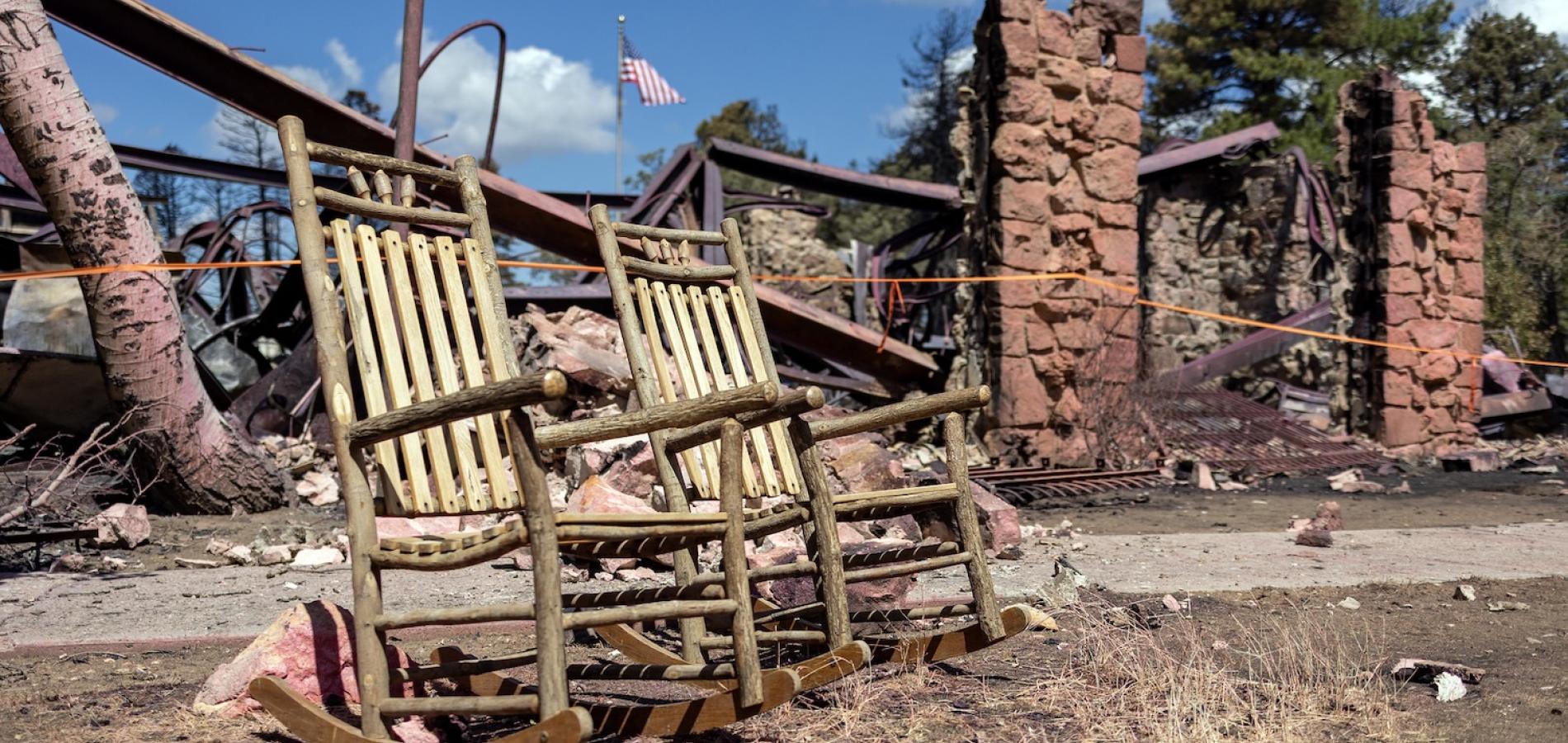
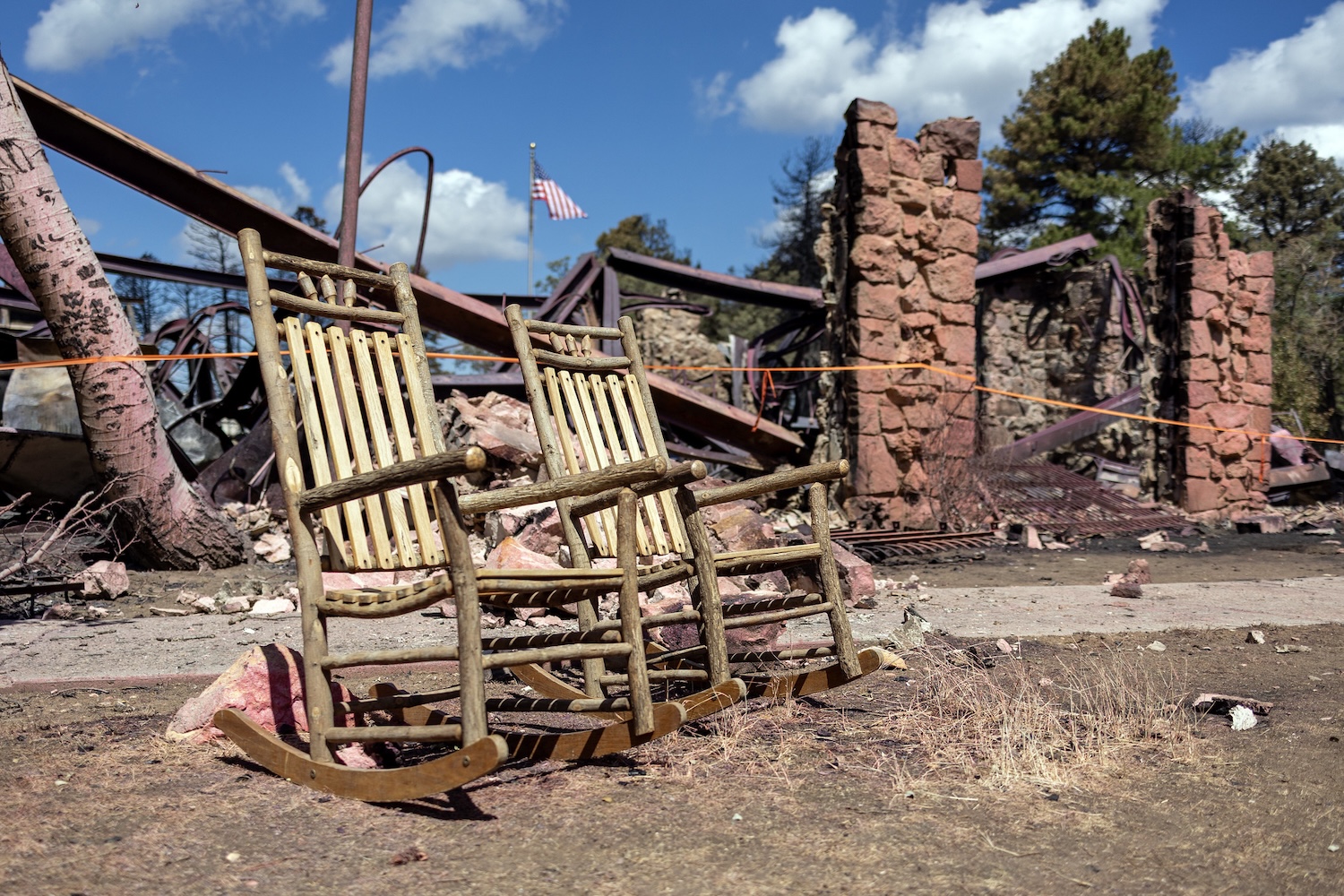
To rebuild, or not to rebuild, the Grand Canyon Lodge that was consumed by the Dragon Bravo Fire on Grand Canyon National Park's North Rim in early July is a growing topic. While Interior Department officials say they're committed to rebuilding visitor facilities that have stood on the lip of the rim for nearly a century, there also have been calls for "rewilding" the burned areas, for keeping visitor lodging facilities outside of the park.
Historian Alfred Runte, author of National Parks: The American Experience, argues that it would be a mistake not to rebuild on the site of the historic lodge, which itself was a reincarnation of the first lodge that burned down in 1932.
Here is his argument:
As John Muir eloquently reminded us, national parks are “foundations of life.” By that he meant for people, not just wilderness, nor need everyone’s method of enjoyment copy his.
No matter, the ashes of Grand Canyon Lodge and cabins had barely cooled before purists applauded their demise. Those buildings never should have been there in the first place. Finally, wilderness might prevail.
The unassailable rebuttal is that American culture founded the parks, not wilderness, which now is equally the poorer without the lodge. For millions, it was not an intrusion but rather a rite of passage, presaging or ending a glorious trip.
Life-changing experiences come in many forms. Looking into wilderness can be no less inspiring than entering it, and may in fact be the gentler touch. Wilderness is after all a human construct, in which campgrounds and trails are intrusions too.
In 2019, Paris nearly lost Notre Dame Cathedral. Say the French had just let it collapse. France instead ignored the financial obstacles and restored its cultural cement.

I doubt most foreign visitors know the history of wilderness, as told in my book, for example, National Parks: The American Experience. Millions, however, understand park lodges as grand evidence of our cultural cement.
Grand Canyon Lodge was a veritable treasure. A century ago, before the banality of modern architecture gripped the country, public buildings rose to greatness. Led by railroad stations, post offices, and yes, national-park lodges, Americans learned to build for beauty.
When Theodore Roosevelt in 1903 said not to mar Grand Canyon, he did not mean keeping people out. He meant banality—ramshackle buildings thrown up for the sake of making a buck.
He himself arrived at South Rim by train, disembarking where two years later would open its stunning masterpiece, the rustic El Tovar Hotel.
Roosevelt among them, the founders of our national parks were not naive. Parks originating in a divided, tight-fisted Congress needed a broad range of incentives to survive.
Once approved, the real job of park-making began. America’s founding preservationists, from the Sierra Club to the American Civic Association, turned repeatedly to the country’s railroads for the essential infrastructure Congress refused to fund.
Addressing the Sierra Club, John Muir again said it best. “Even the soulless Southern Pacific R.R. Co., never counted on for anything good, helped nobly in pushing the bill for this park through Congress.”
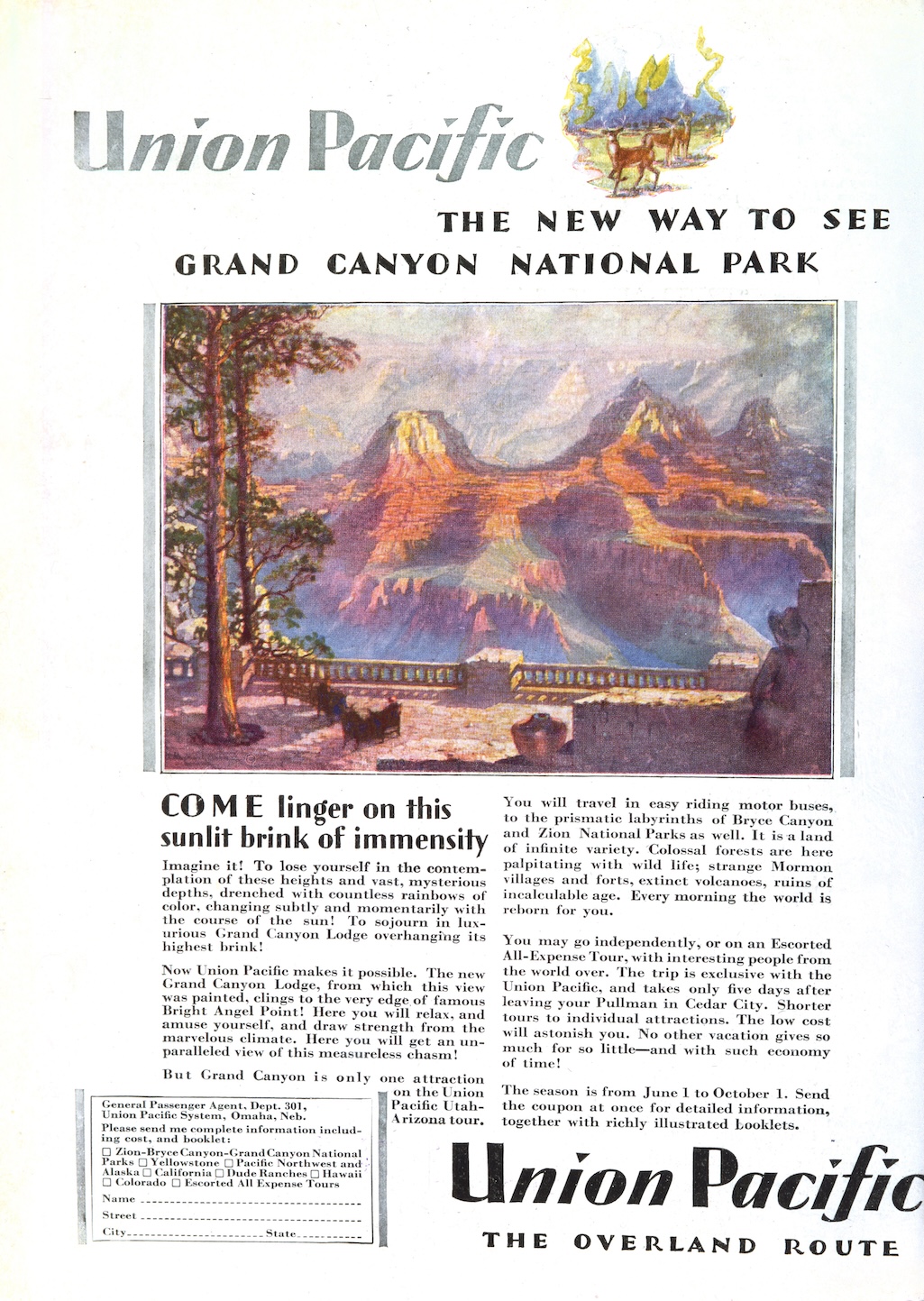
The bill he referenced, establishing Yosemite National Park, passed in 1890. At Grand Canyon, the railroad of the hour was the Santa Fe and its El Tovar. Twenty years later, at North Rim, the Union Pacific Railroad (UP), through its subsidiary the Utah Parks Company, retained Gilbert Stanley Underwood to design and build Grand Canyon Lodge.
Also by Underwood, Cedar Breaks Lodge, Zion Park Lodge, and Bryce Canyon Lodge rounded out UP’s so-called Celestial Circuit.
Beginning in 1923, visitors from across the country arrived Cedar City, Utah, by train, transferring to motor coaches for their tours.

Underwood’s last major undertaking, Jackson Lake Lodge in Grand Teton National Park, completed an impressive 30-year career in the parks. Ever been there? Then you know. There is no more glorious “preview” of the Teton wilderness.
Same for his Ahwahnee Hotel, opened in Yosemite Valley in 1927. The point remains: Architecture predated biology in advancing the national park idea. America’s Notre Dame, if you will, was scenery. Monumental scenery was for every Western park the critical opening wedge for wilderness.
The problem we face is honoring history. No longer is it fashionable to speak of culture as an achievement, so obsessed have we become with pointing out its failures.
If only we could start over, say some. And that’s the even bigger point: We can’t. Columbus sailed, and the world sailed with him. Faulting reality is not the answer to reconciling the best and worst of our nation’s past.
At 78, and no longer a backpacking 28, I still see culture and wilderness as equals. Such was the Grand Canyon Lodge—the equal of wilderness, not its nemesis.
What is the proper future for North Rim? Rebuild! Affirm wilderness, yes, but not at the expense of the history that made it possible.
Unavoidably, every brick, timber, and window will be new. The point is that the vision will remain the same. We have the blueprints; we still have the footprint. There is nothing more a good contractor needs.
In fact, UP first replaced the lodge in 1937, after the 1928 original burned in 1932. In 1966 Zion Park Lodge suffered a similar fate, after which park and company officials rebuilt it in just 108 days!
Granted, that was the Old America—the Can-Do America. No doubt, whatever happens next at North Rim, legions of bureaucrats will insist on a say.
History reminds us to stay firm. The faster we rebuild Grand Canyon Lodge, the less painful will be its loss. Make it a year—no more than two. Pay top wages and attract the best artisans so there will be no protracted delays.

Still the survival of our best idea depends on the broadest constituency possible. To my mind, the real threat to wilderness is across the canyon, where scores of wind turbines mar the view. Or deep in the canyon, where remain two dam sites thirsty Westerners would love to flood.
Grand Canyon Lodge enhanced the view for millions who otherwise might never have believed in wilderness. That is a worthy “fountain of life” in my estimation, and forever reason to renew its glory.
Now in its fifth edition, Alfred Runte’s National Parks: The American Experience (Lyons Press) has been in print for 46 years. His latest book is Trains for Nature: Railroads and the American Land (also Lyons Press). His next book, a defense of the national park idea, is in part based on his articles over the years for the National Parks Traveler.
Stories about:
A copy of National Parks Traveler's financial statements may be obtained by sending a stamped, self-addressed envelope to: National Parks Traveler, P.O. Box 980452, Park City, Utah 84098. National Parks Traveler was formed in the state of Utah for the purpose of informing and educating about national parks and protected areas.
Residents of the following states may obtain a copy of our financial and additional information as stated below:
- Florida: A COPY OF THE OFFICIAL REGISTRATION AND FINANCIAL INFORMATION FOR NATIONAL PARKS TRAVELER, (REGISTRATION NO. CH 51659), MAY BE OBTAINED FROM THE DIVISION OF CONSUMER SERVICES BY CALLING 800-435-7352 OR VISITING THEIR WEBSITE. REGISTRATION DOES NOT IMPLY ENDORSEMENT, APPROVAL, OR RECOMMENDATION BY THE STATE.
- Georgia: A full and fair description of the programs and financial statement summary of National Parks Traveler is available upon request at the office and phone number indicated above.
- Maryland: Documents and information submitted under the Maryland Solicitations Act are also available, for the cost of postage and copies, from the Secretary of State, State House, Annapolis, MD 21401 (410-974-5534).
- North Carolina: Financial information about this organization and a copy of its license are available from the State Solicitation Licensing Branch at 888-830-4989 or 919-807-2214. The license is not an endorsement by the State.
- Pennsylvania: The official registration and financial information of National Parks Traveler may be obtained from the Pennsylvania Department of State by calling 800-732-0999. Registration does not imply endorsement.
- Virginia: Financial statements are available from the Virginia Department of Agriculture and Consumer Services, 102 Governor Street, Richmond, Virginia 23219.
- Washington: National Parks Traveler is registered with Washington State’s Charities Program as required by law and additional information is available by calling 800-332-4483 or visiting www.sos.wa.gov/charities, or on file at Charities Division, Office of the Secretary of State, State of Washington, Olympia, WA 98504.


