

Morning scenery at Ruby Beach, Olympic National Park / Rebecca Latson
Olympic National Park is the place to go if you ever want to visit a national park covering a little bit of everything. Within an expanse of almost 1 million acres, you’ll see beaches, forests, and mountains veined with a network of clear, cold streams, rivers and waterfalls.
Because of the size of this national park, I made not one, but two trips, this year, from my home in central Washington. I didn’t get to all the places I’d intended, but I've covered enough territory to present you with another Armchair Photography Guide which you can use for fostering your own photographic adventures along the Olympic Peninsula.
If you are new to the Traveler or new to this photography column, I created these Armchair Photography Guides for those of you who cannot, or do not want to, hike long trails or deep into the backcountry with a pack full of camera gear. I believe you can achieve amazing images from pullouts, view areas, and along short trails with your smartphone, point-and-shoot, or SLR camera using tips and techniques I provide in these guides.
My January trip was short in duration and coincided with the partial government shutdown. I wrote a previous article for the Traveler about this visit. My recent late August / early September trip lasted a week, during which I managed to cover ocean, forest, and mountain views of this national park. Because there is so much to encompass, photographically, I figured I’d focus on the beaches in this article, with subsequent installments for the forests and mountains.
The map below delineates my combined winter and summer route through the park (yellow lines) and the route I took to visit the beaches listed here (red line). The photos you see in this article are a combination of mostly summer shots and a few winter images.

The photographic route through Olympic National Park / NPS / Rebecca Latson
When planning your own trip to the coastal portions of Olympic National Park, be aware that, during the winter, the crowds are generally sparse, but the weather is wet and inclement and beach access might be a little more difficult due to trail washouts and huge logjams from storms. Summer access is considerably easier, with repairs to storm-damaged stairs and cleared paths around beached logs. While there are more crowds during the summer, early mornings and very late evenings are great for good lighting conditions and fewer people.
Kalaloch Beach
Let’s start this trip along the peninsula traveling south to north, with the first stop at Kalaloch Beach, below Kalaloch Lodge.
While there are no sea stacks here, there are rocks onto which waves crash for dramatic shots. To freeze the motion of a crashing wave, use a fast shutter speed and the “burst method” of holding your finger down on the shutter button for 4 – 5 clicks. Since fast shutter speeds (fps) mean less light going through the lens, you’ll want to open your aperture to maybe f/4 – f/6.3 and/or bump up the ISO anywhere from 250 to 1250, depending upon the time of day you are at the beach. SLRs and some point-and-shoot cameras have manual and aperture / shutter priority settings. If you are using a smartphone, touch that little white shutter button several times in succession for at least one clear shot. Use your telephoto lens or zoom setting on your point-and-shoot or smartphone to get really close to those waves (without getting wet and being pulled under by riptides).
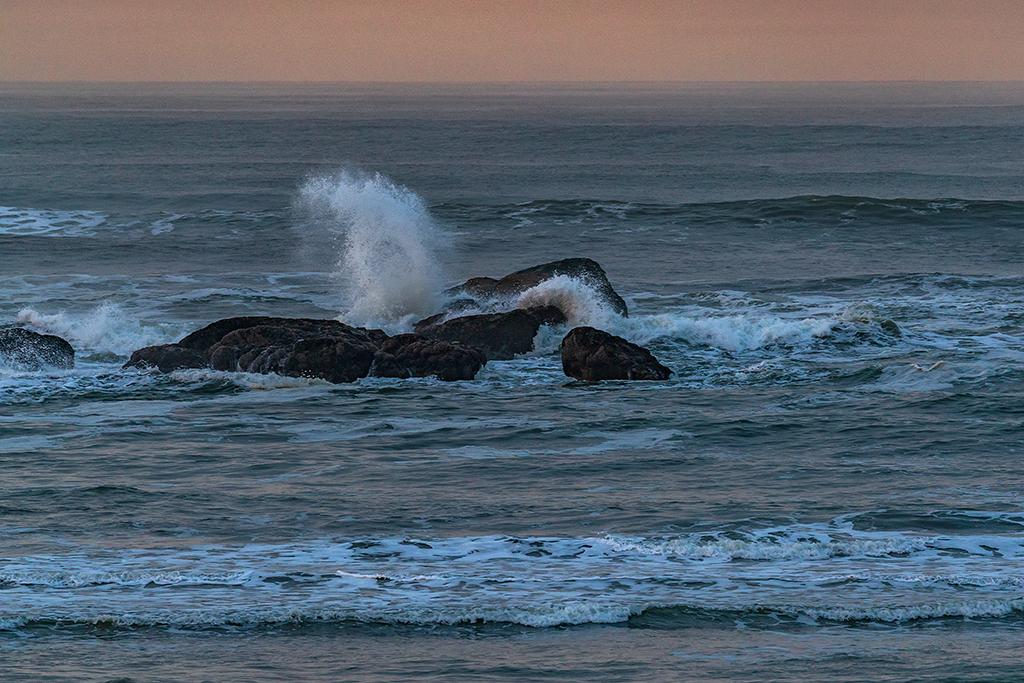
Crashing waves at Kalaloch Beach, Olympic National Park / Rebecca Latson
To capture the full spectacle of ocean motion and stormy skies (especially prevalent during the winter months), set your camera on a tripod and make use of either a circular polarizer (CPL) or a graduated neutral density (grad ND) filter to darken the horizon and delineate cloud texture. For those of you not familiar with CPL or grad ND filters, check out this article I wrote for the Traveler.
Tide levels change with the season, and summer mornings produce very low tides at this beach with plenty of rocky tidepools to explore. Use your CPL to remove glare and reflections when photographing through the water. Smooth, ripple-free tidepool shots of anemones’ floating tentacles are best in the morning. Mornings are also great for mirror-still reflections of sky and scenery in pools of water along the beach during low tide.
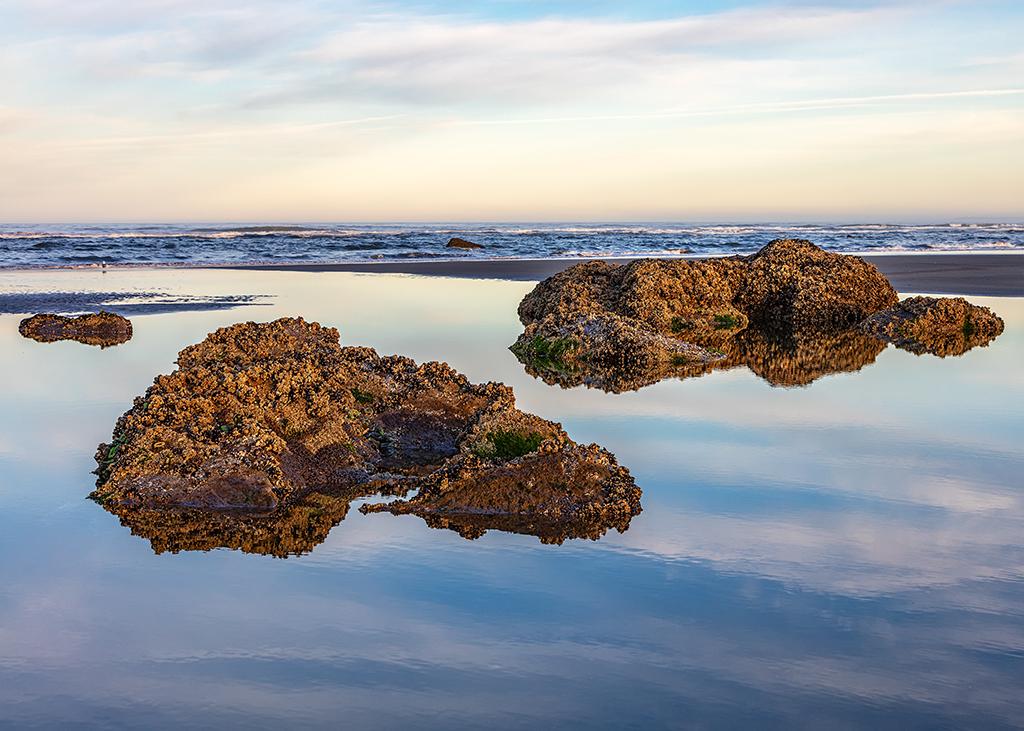
Rocks, reflections, sand, sea, and sky, Kalaloch Beach, Olympic National Park / Rebecca Latson
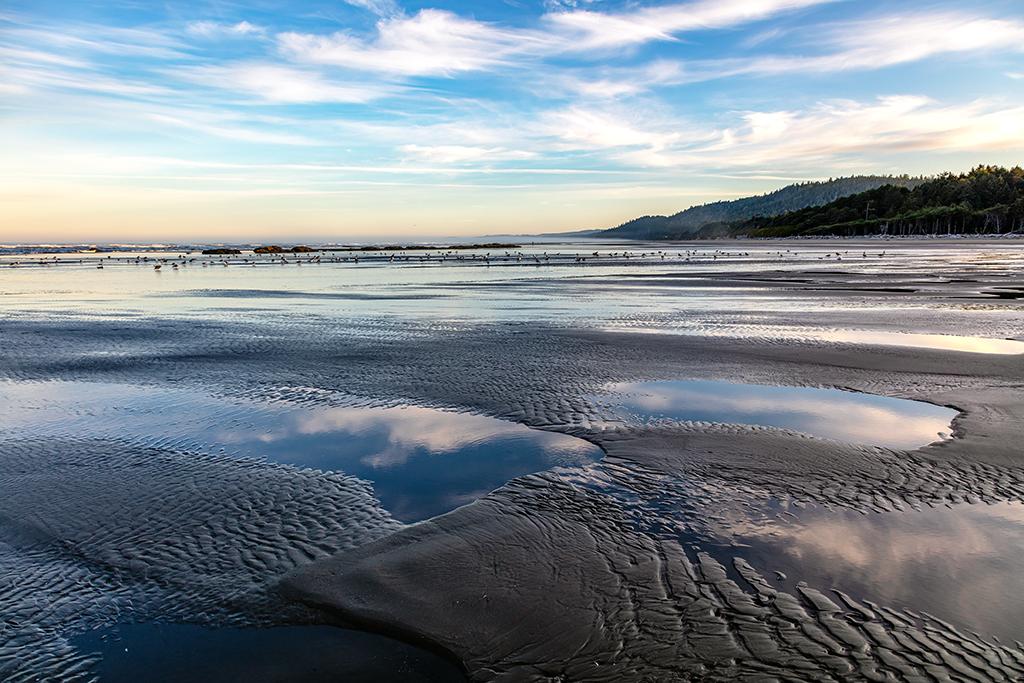
Morning low tide scenery along Kalaloch Beach, Olympic National Park / Rebecca Latson
Turn your camera away from the ocean and concentrate on outcrops. Make sure your settings are adjusted to account for the darker exposure of the trees and shrubs populating the high bluffs.
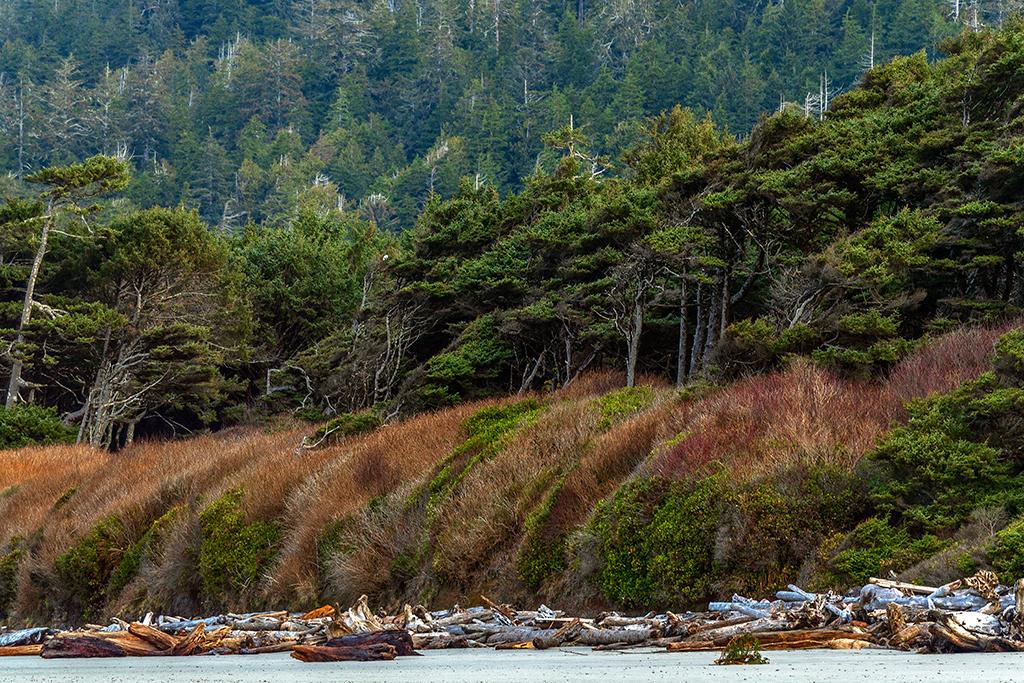
Bluff scenery at Kalaloch Beach, Olympic National Park / Rebecca Latson
Consider adding Kalaloch Lodge or those bluff-side cabins to a couple of your shots. These buildings add an interesting perspective and sense of scale. Same thing goes for adding a few people to your beach scenes. They might be little stick figures in the distance, but they still provide a sense of scale and even some depth to your image.
Capture a shot of the gulls flocked on the ground or in the air.
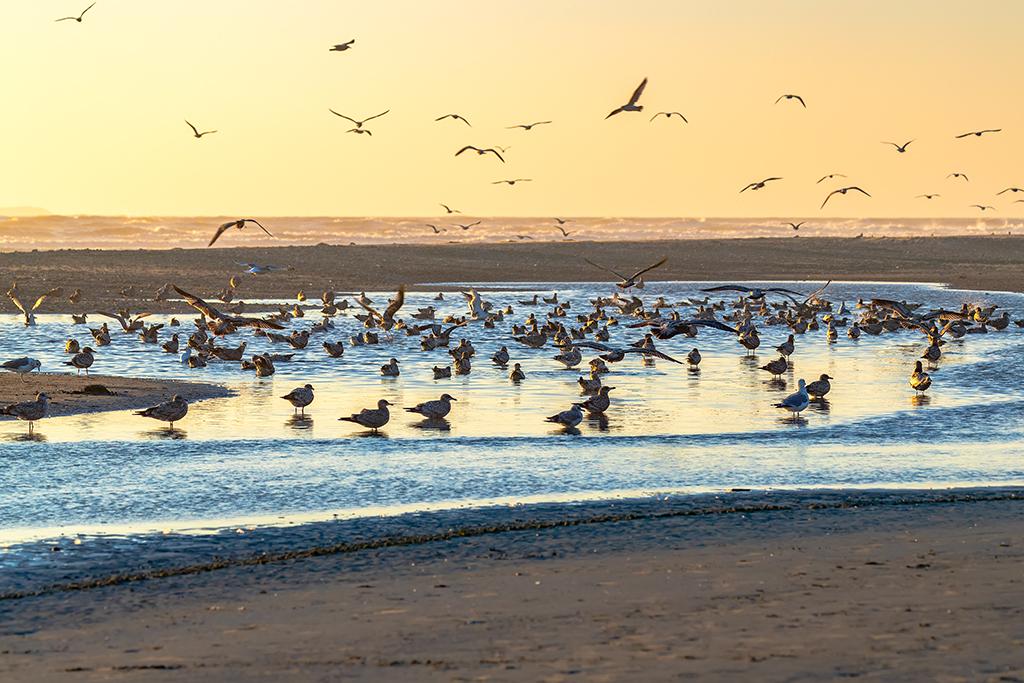
Gulls on the ground at Kalaloch Beach, Olympic National Park / Rebecca Latson
Use your smartphone, your SLR’s or point-and-shoot’s video mode, or a dedicated video camera and pan around the landscape. It's especially cool to get a video of the evening tide flowing in against the current of Kalaloch Creek.
Sunrises along the Olympic coast are pastel affairs, with light pinks, lemony yellows and pale blues coloring the sky westward. Mornings provide a little bit of fog, too, which may be heavy or light, depending upon the weather.
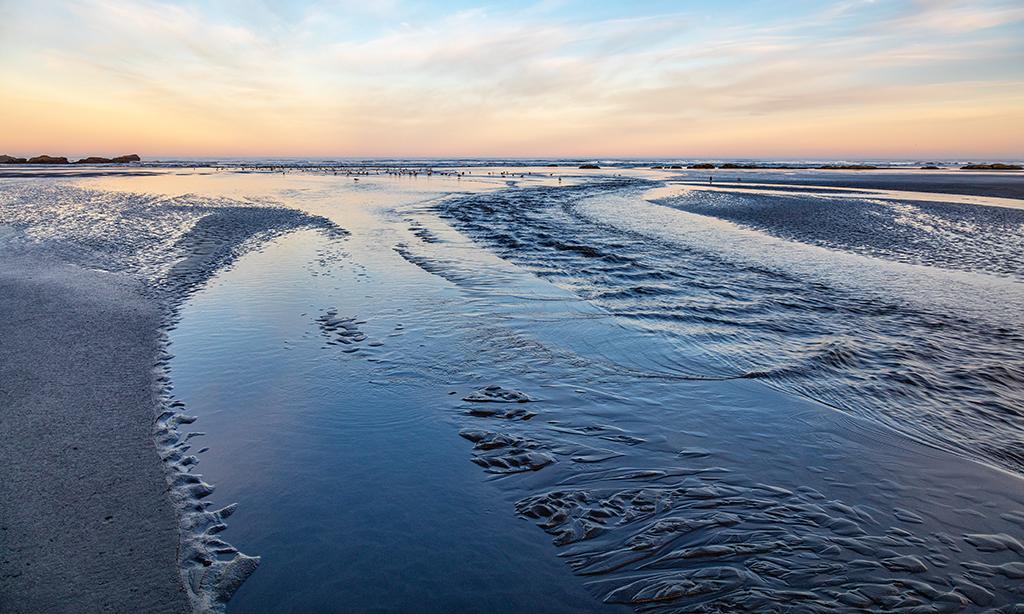
Sunrise on Kalaloch Beach, Olympic National Park / Rebecca Latson
Sunsets are showy. While you can handhold your camera for sunrise shots, you might want to use a tripod for those sunsets, because the landscape below the horizon line will darken sooner than the sky above the horizon line. You’ll definitely want to use a grad ND filter to prevent overexposing (“blowing out”) the area above the horizon. Those of you with smartphones can tap on a brighter portion of your viewfinder to darken the brightness a bit, or, you can try what a visitor from Boston did and use your sunglasses in front of your phone camera lens. Hey, whatever works!

An iPhone shot of the beginning of sunset, Kalaloch Beach, Olympic National Park / Rebecca Latson

Sunset at Kalaloch Beach, Olympic National Park / Rebecca Latson
As the sun continues to sink and the landscape darkens, keeping your camera on a tripod is highly recommended, as a slower shutter speed is needed to allow more light through the lens to your camera’s sensor. An added benefit to the slower shutter speed is what photographers call the “silky water” effect, about which I wrote in a previous Traveler article. Slow shutter speeds make moving water smooth(er) and satiny, creating a dreamy quality to images.

Sunset's afterglow at Kalaloch Beach, Olympic National Park / Rebecca Latson
Use your telephoto lens or telephoto setting on your point-and-shoot or smartphone to capture a more intimate image of the amazing sunsets you'll see at this beach.

A telephoto sunset at Kalaloch Beach, Olympic National Park / Rebecca Latson
While at Kalaloch, you should definitely view the famous “Tree of Life,” a Sitka spruce holding its own over a bluff undercut by stream erosion. Drive north from the Kalaloch Lodge to the Kalaloch Campground’s day-use parking lot. Hike down the steps to the beach, turn right and walk about 50 yards. You can’t miss it. Sure, there are a gazillion photos of this natural oddity, but the photo you capture will be your own, taken with your own camera.

The "Tree of Life" aka the "Tree Cave," Kalaloch Beach, Olympic National Park / Rebecca Latson
Beach 4
The beaches around Kalaloch are numbered and in my opinion, Kalaloch Beach 4 is one of the best of these, complete with a parking lot, restrooms, and a well-maintained trail ending at a bridge over a outcrop of tilted and overturned sedimentary rock layers through which runs a clear stream out to the ocean. You’ll have to do a little clambering down to get to the beach, but it’s not difficult, even for those of you with short legs, like me. I sat down on my rump and slid my way to the sandy ground. Before you do that, though, get some leading line shots of the trail and the bridge. The leading line technique guides your photo audiences’ eyes from one part of the photo to another. This technique also creates a sense of “where” and “what,” as in “where will that trail / bridge / road take you” and “what adventure awaits at the end of the trail, or across that bridge, or down the road?”
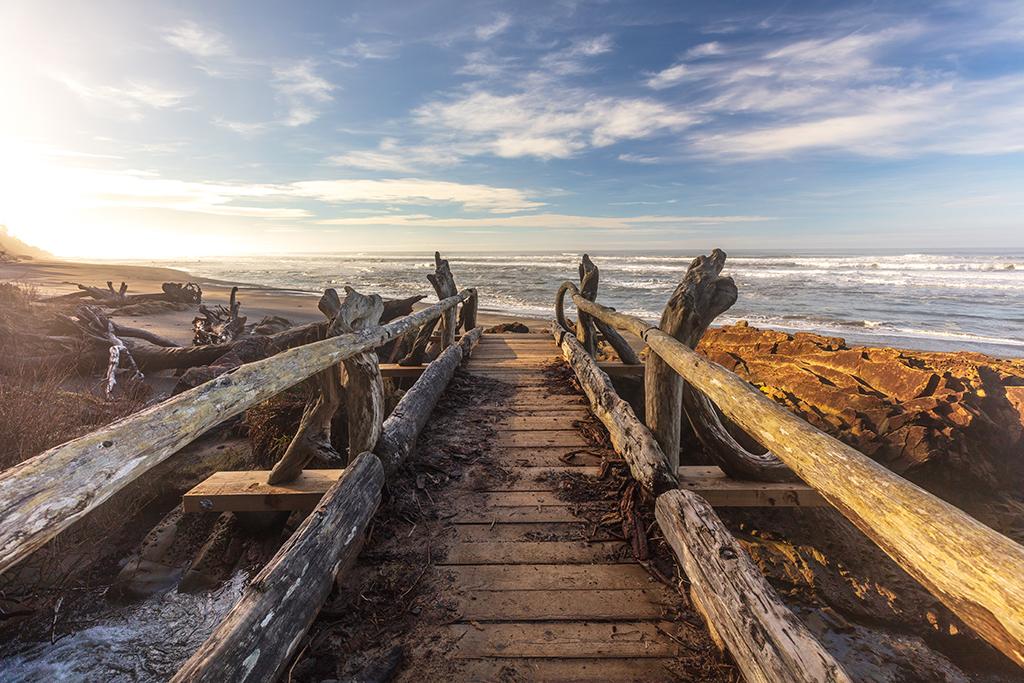
The bridge to Beach 4, Olympic National Park / Rebecca Latson
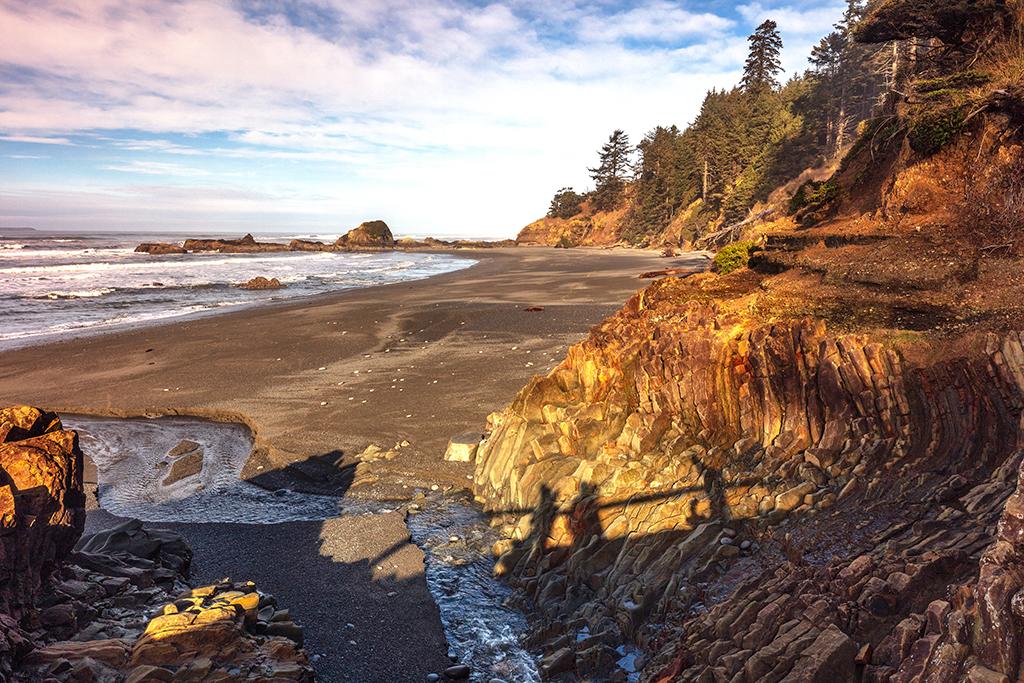
Tilted beds and Beach 4 scenery, Olympic National Park / Rebecca Latson
Ruby Beach
From Beach 4, it’s a little over 4 miles further north on Hwy 101 to Ruby Beach, famous for its rock islands (sea stacks) such as Abbey Island. Arrive there early on a summer morning prior to 8:00 a.m. or later in the afternoon, around 6:00 p.m. when low tides allow for exploration of the tide pools up against Abbey Island.

A Ruby Beach tide pool, Olympic National Park / Rebecca Latson

Tide pool life, Ruby Beach, Olympic National Park / Rebecca Latson

Green anemones, Ruby Beach, Olympic National Park / Rebecca Latson
Practice your powers of observation and look for patterns and texture in the sand. Look for rivulets and ripple marks. Use parts of the sea stacks and rock outcrops as natural frames. Photograph interesting reflections in the pools of seawater on the sand. You might need to use a grad ND to keep the distant landscape from blowing out while you expose for the darker foreground beach and rocks.

Rivulets and runoff into the ocean, Ruby Beach, Olympic National Park / Rebecca Latson

Abbey Island reflections, Ruby Beach, Olympic National Park / Rebecca Latson
If you are at this beach during sunrise or shortly thereafter, point your camera toward any single points of sunlight you see peeking through the trees along the high bluff to achieve the sunburst effect. You can do the same at this beach in the evening, if you choose to remain for sunset shots (which I highly recommend), by looking for single points of sunlight through the trees atop Abbey Island.

Sunburst over the bluff at Ruby Beach, Olympic National Park / Rebecca Latson
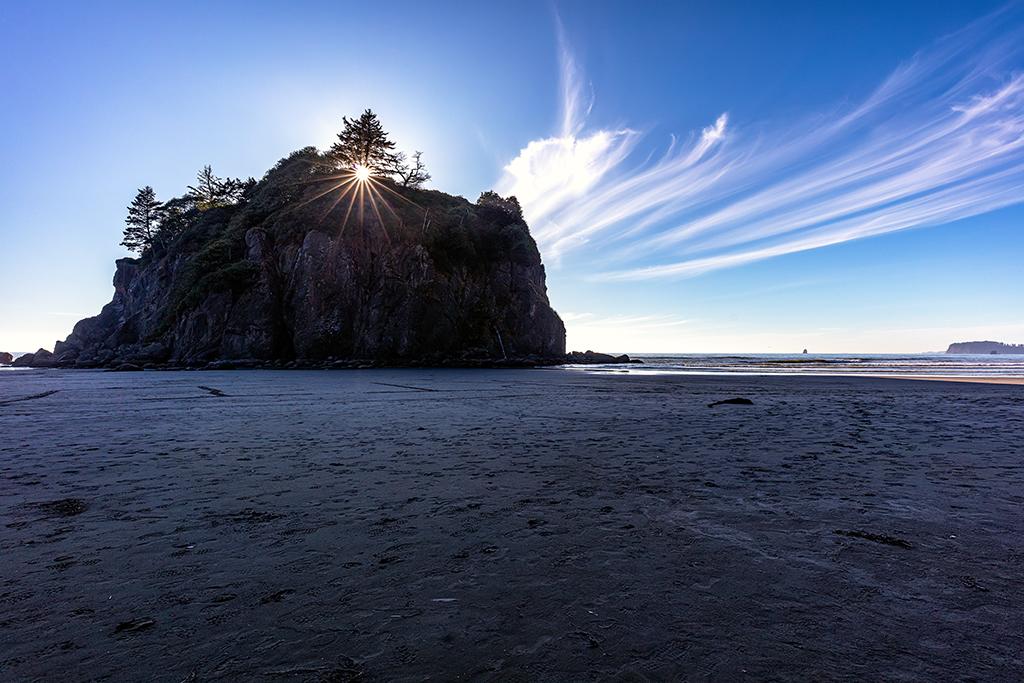
An Abbey Island sunburst, Ruby Beach, Olympic National Park / Rebecca Latson
To capture both the setting sun and Abbey Island, you’ll need your wide-angle lens (16mm to 35mm) or wide-angle setting on your point-and-shoot.

Sunset at Ruby Beach, Olympic National Park / Rebecca Latson
Don’t forget to zoom in for close shots of Abbey Island and the colorful sky around that silhouetted sea stack.

Sunset scenery at Ruby Beach, Olympic National Park / Rebecca Latson
Remain at or near the beach after sunset. The sun sinks and it’s a little dark for a moment, then suddenly there is a “last hurrah” explosion of color lighting up the sky before twilight settles in. Keeping your camera on a tripod is the best method for capturing the scene, but if you have already dismantled your gear (like I had while carrying it back up the trail to the parking lot), then handheld shots using a wider aperture and higher ISO will reward you with incredible images, as well. Your point-and-shoot on Auto as well as your smartphone will adjust for the differences in light well enough to obtain some very nice images.

Sunset's "last hurrah" at Ruby Beach, Olympic National Park / Rebecca Latson
Rialto Beach
From Ruby Beach, head north on Hwy 101, turn left onto 110, and head toward the community of La Push. Turn right onto Mora Road and drive to Rialto Beach, with its large parking lot and very easy access. Depending upon your time of arrival, the atmosphere might be hazy and you’ll need to use your CPL filter and adjust your settings for the bright, flat light. If you use your smartphone, tap on the brightest spot you see in the viewfinder and your phone should adjust its exposure accordingly.

A telephoto landscape of Rialto Beach sea stacks, Olympic National Park / Rebecca Latson
Use your wide-angle lens or wide-angle point-and-shoot setting for shots of the beach, bluff and sea stacks, and your telephoto lens for closer views of the sea stacks in the distance. You might also get lucky and capture pelicans cruising the currents or riding the waves.

Cruising the currents at Rialto Beach, Olympic National Park / Rebecca Latson
Don't forget to get a video panning from one side of the beach to the other.
Hunker down closer to the ground for a slightly different perspective of the landscape.

Sea stack scenery at Rialto Beach, Olympic National Park / Rebecca Latson
A 1.5-mile trek over a mostly pebbly beach with areas of packed sand will take you toward tide pools and sea stacks with such names as “Split Rock” and “Hole-in-the-Wall.” As you walk along, look up to the treetops lining the bluff where you might just see a bald eagle, or two. Consult a tide chart before making the trudge out and back, as you don’t want to get caught during high tide.

A nice perch to view the ocean at Rialto Beach, Olympic National Park / Rebecca Latson
I’ve emphasized this bit in previous Traveler articles, and I’ll write it here, too. I encourage you to visit the same place in a park more than once, if you can, under different weather conditions and during different seasons and times of day, because the same scene can look markedly different each time. The images below of Ruby Beach should give you an idea of what I mean.

A winter view of Ruby Beach, Olympic National Park / Rebecca Latson

A summer view of Ruby Beach, Olympic National Park / Rebecca Latson

A summer sunset view of Ruby Beach, Olympic National Park / Rebecca Latson
When you return to your room, camper or tent at night, remember to wipe down your camera and lens to remove any salt and sand residue. Be mindful, too, when switching lenses on the beach, because you don’t want that salty, sandy residue inside either camera or lens.
In truth, you could spend your entire trip simply touring the beaches within Olympic National Park, including Shi Shi Beach way up north on the peninsula, the beaches around Ozette, and beaches south of La Push. There’s plenty of scenery to explore and you are now armed with tips, techniques and gear suggestions for great Olympic coast photos.
One more piece of advice: Don’t just opt for a “grab shot.” If you want to capture a wide-angle shot of a lovely landscape or a close-up view of sea life in a tide pool, give a little thought to your composition and placement of your subject. For a great image and a photo story your audience can appreciate and understand, composition is everything.
The next installment of my Armchair Photography Guide to Olympic National Park will feature the forests, from the Quinault Rainforest to the Hoh Rainforest to the Sol Duc Valley to the forest around Lake Crescent.
Stories about:
A copy of National Parks Traveler's financial statements may be obtained by sending a stamped, self-addressed envelope to: National Parks Traveler, P.O. Box 980452, Park City, Utah 84098. National Parks Traveler was formed in the state of Utah for the purpose of informing and educating about national parks and protected areas.
Residents of the following states may obtain a copy of our financial and additional information as stated below:
- Florida: A COPY OF THE OFFICIAL REGISTRATION AND FINANCIAL INFORMATION FOR NATIONAL PARKS TRAVELER, (REGISTRATION NO. CH 51659), MAY BE OBTAINED FROM THE DIVISION OF CONSUMER SERVICES BY CALLING 800-435-7352 OR VISITING THEIR WEBSITE. REGISTRATION DOES NOT IMPLY ENDORSEMENT, APPROVAL, OR RECOMMENDATION BY THE STATE.
- Georgia: A full and fair description of the programs and financial statement summary of National Parks Traveler is available upon request at the office and phone number indicated above.
- Maryland: Documents and information submitted under the Maryland Solicitations Act are also available, for the cost of postage and copies, from the Secretary of State, State House, Annapolis, MD 21401 (410-974-5534).
- North Carolina: Financial information about this organization and a copy of its license are available from the State Solicitation Licensing Branch at 888-830-4989 or 919-807-2214. The license is not an endorsement by the State.
- Pennsylvania: The official registration and financial information of National Parks Traveler may be obtained from the Pennsylvania Department of State by calling 800-732-0999. Registration does not imply endorsement.
- Virginia: Financial statements are available from the Virginia Department of Agriculture and Consumer Services, 102 Governor Street, Richmond, Virginia 23219.
- Washington: National Parks Traveler is registered with Washington State’s Charities Program as required by law and additional information is available by calling 800-332-4483 or visiting www.sos.wa.gov/charities, or on file at Charities Division, Office of the Secretary of State, State of Washington, Olympia, WA 98504.


Comments
A really good article, Rebecca. And great photos and advice, as usual.
I really like how you captured the power of the ocean by turning your camera away from it for 'Bluff scenery at Kalaloch'. The transition from reddish brush to green forest marks the trimline created by the highest winter surf that is rearranging the beach logs from year to year. Even lesser storms with ten-foot waves, rather than winter's thirty-plus footers, can effectively cancel low tides for days.
Well done! I spent a great deal of my youth and young adult life camping in that area. You captured it wonderfully.
rebecca - take me along with you.. anywhere!
We visited Olympic National Park several years ago. The photos bring back mrmories. We saw a lot of sea stars in the tide pools at low tide.