
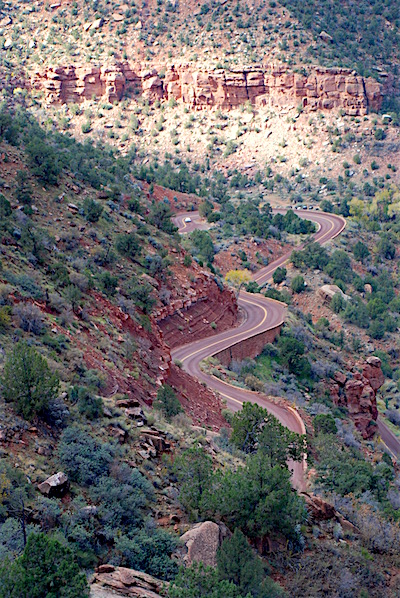
National Park Service officials are evaluating a request to allow a professional bike race to launch its first stage with a steep climb out of Zion National Park in southwestern Utah.
It's months off, and details haven't been finalized, but organizers of the annual Tour of Utah bicycle race hope to start the week-long race through the park's red-rock canyon.
Professional bike racing and national parks long have been controversial -- years ago Yosemite National Park officials declined a request to run a race through Yosemite Valley, and more recently the Park Service declined a request for a pro bike race to weave through Colorado National Monument -- but the appeal of peletons streaming through the grandeur of a national park keeps race organizers coming back again and again to seek permission.
In the case of the 2016 Tour of Utah, organizers hope to start at Zion Canyon Village just outside the park's Springdale entrance, head through the park and the Zion-Mount Carmel Tunnel, out of the park, and then north on U.S. 89 to Cedar City.
"We're not quite sure how we're getting [to Cedar] yet," Jenn Andrs, the Tour's executive director, said Thursday when the 2016 tour was announced. "We've worked closely with the national parks in the past, and we do have a good relationship there, so we're hopeful."
The tour has been somewhat controversial with its national park connections in the past. In 2013, the tour's decision to pedal along Utah 12 through Bryce Canyon National Park and Utah 143 through Cedar Breaks National Monument -- drew complaints from Public Employees for Environmental Responsibility. The group's concern was that if the Park Service stood quietly back when it came to the Tour of Utah simply because the race will follow state-branded highways, would the agency permit a similar bike race down U.S. 191, which passes through a section of Yellowstone National Park and Grand Teton National Park, one through Great Smoky Mountains National Park via U.S. 441, aka the Newfound Gap Road, or around Acadia National Park via State Route 3?
At the time, the Coalition to Protect America's National Parks (then known as the Coalition of National Park Service Retirees), sided with PEER and wished out loud that, "it would have been helpful for the National Park Service to work with the race organizers to issue a clear public message regarding the Tour of Utah and why it is being permitted on roads in the two park units."
Intermountain Regional Director Sue Masica said Thursday evening from her Denver office that the Park Service was reviewing the request, but hadn't made a decision for or against the race rolling through Zion.
"What we’ve tried to have is a structured process by which parks go through and evaluate the potential impacts and look at what’s proposed. Each race is different, each park is different, and we try to work through the regulatory and policy framework as to whether those events would be appropriate for the issuance of a special use permit for the event to proceed," she said.
Zion Superintendent Jeff Bradybaugh, in an email, said, "We have been working with them to clarify the planning requirements associated with this event, specifically those involving public safety and traffic management concerns, which require resolution before the process could move forward."
In March 2011, during a public debate over whether the Quiznos Pro Challenge could run a leg through Colorado National Monument, Park Service Director Jon Jarvis said such an event was "neither necessary nor appropriate" for a unit of the National Park System.
“Closing the park to accommodate the needs of a commercial bike race goes against our management policies, would adversely impact park resources, and would deny access to the park to other visitors,” said the director at the time. “Federal law and NPS policy restrict commercial activities in national parks to those that are ‘necessary and appropriate’ to park purposes. This bike race is neither necessary nor appropriate in the park."
Story Categories:
A copy of National Parks Traveler's financial statements may be obtained by sending a stamped, self-addressed envelope to: National Parks Traveler, P.O. Box 980452, Park City, Utah 84098. National Parks Traveler was formed in the state of Utah for the purpose of informing and educating about national parks and protected areas.
Residents of the following states may obtain a copy of our financial and additional information as stated below:
- Florida: A COPY OF THE OFFICIAL REGISTRATION AND FINANCIAL INFORMATION FOR NATIONAL PARKS TRAVELER, (REGISTRATION NO. CH 51659), MAY BE OBTAINED FROM THE DIVISION OF CONSUMER SERVICES BY CALLING 800-435-7352 OR VISITING THEIR WEBSITE. REGISTRATION DOES NOT IMPLY ENDORSEMENT, APPROVAL, OR RECOMMENDATION BY THE STATE.
- Georgia: A full and fair description of the programs and financial statement summary of National Parks Traveler is available upon request at the office and phone number indicated above.
- Maryland: Documents and information submitted under the Maryland Solicitations Act are also available, for the cost of postage and copies, from the Secretary of State, State House, Annapolis, MD 21401 (410-974-5534).
- North Carolina: Financial information about this organization and a copy of its license are available from the State Solicitation Licensing Branch at 888-830-4989 or 919-807-2214. The license is not an endorsement by the State.
- Pennsylvania: The official registration and financial information of National Parks Traveler may be obtained from the Pennsylvania Department of State by calling 800-732-0999. Registration does not imply endorsement.
- Virginia: Financial statements are available from the Virginia Department of Agriculture and Consumer Services, 102 Governor Street, Richmond, Virginia 23219.
- Washington: National Parks Traveler is registered with Washington State’s Charities Program as required by law and additional information is available by calling 800-332-4483 or visiting www.sos.wa.gov/charities, or on file at Charities Division, Office of the Secretary of State, State of Washington, Olympia, WA 98504.


National parks and their natural resources belong to you. The National Parks Traveler works to ensure you know how these essential places are being cared for.
Sign Up For Our Weekly Newsletter
Unsubscribe at any time.
INN Member

The easiest way to explore RV-friendly National Park campgrounds.

Here’s the definitive guide to National Park System campgrounds where RVers can park their rigs.
Our app is packed with RVing- specific details on more than 250 campgrounds in more than 70 national parks.
You’ll also find stories about RVing in the parks, tips helpful if you’ve just recently become an RVer, and useful planning suggestions.


Comments
I think the Tour of Utah is appropriate for Zion. Im sure they will be in and out of there in no time. Many of the communities down here love the attention the Tour of Utah brings to there towns. Its not like the Ironman or Ragnar, where thousands of athletes are streatched out for miles and hours. I'm excited to see that Escalante is a host town and plan to go see it there. I went to the race celebration in Escalante a couple of years ago and it was a hoot. Many of the communities down here aren't getting the financial windfall that Springdale and SG are experiencing with the bump in tourism. I certainly understand the concerns of the NPS, but some communities and businees owners appreciate and need the media attention. I think a 30-60 minute delay in Zion is reasonable given the greater good the event brings to surrounding communities.
Mark, I think you might be underestimating the time of delay. I'd figure more like three or four hours, at least, when you factor in set-up, support wagons, TV film crews, take down, and cleanup.
You'd also have to close both the south and east entrances to the park to visitor traffic in mid-August, little more than a week before the National Park Service Centennial on August 25.
Even if you could sort those things out, how would you deal with spectators? Would they be allowed along the road? How many would want to walk up that highway? Porta-potties?
And then, of course, there are the folks who already have reservations at Zion Lodge for that period. What would their reaction be if they motored up to the park the morning of August 16 and were told they had to wait for several hours for a bike race to pass through?
These are questions the NPS hopefully will find good answers to.
Kurt,
Two years ago, when they went through Escalante, between the first Utah High Patrol vehicle and the last, it was all of about 20 minutes, and that includes one poor guy that was almost 10 minutes behind the peloton. The whole town came out. We all had matching Tour of Utah t-shrts. Even the Mayor brought out all of his old tracktors to line the road. It was a great event and one of the few events that brings together our community. We even had a beer garden and cooked brats the night before.
The TV cameras were on motorcycles. All of the set up is by the movie theatre in Springdale and not in the park according to the press release. Unless you have actually seen a race like the Tour of California, Tour of Utah, etc. you don't realize how quickly they go by. And with Zion being at the start of the race when the race is its most compacted (ie...no sorry rider off the group), it should be quick.
Have you seen one of these races? If not, it would be very difficult to form an educated opinion. I guaranteee you that you are way off base on the 3-4 hours. From what information did you form that opinion?
Again, I'm a resident of Garfield County and if Zion has to have a 30 minute delay to beam my neighboorhood and business to all of those worldwide viewers, I think it is well worth it. We count on tourism dollars these days. We arent getting the $300 room nights that Springdale is getting. We need the marketing and the Tour of Utah is a great avenue. I am biased in that I used to race bikes many years and pounds ago and love to see the top racers in the world on my roads and small town. If you haven't seen one of these events, I do think you need to actually see one before you jump to conclusions. These races are 4-5 hours from point A to point B and don't impact one locale for more than 15-30 minutes.
We have had the Pro Challange Tour come through Breckenridge for the last several years so I can speak from some experience. Delays tend to be relatively short maybe an hour or two for most of the course as there is no "set up" or "shut down". Starts and finishes do have longer delays. However Zion, with its shuttle system seems like it could handle it well. After a few hours of delay in the morning, the shuttles could start to run within minutes of the race's start. The East entrance would have to remain closed for a little longer as they wait from the bike to clear. Once they are through it could open immediately.
As to people along the route, my expereince is that except for starts, finishes and summits, the spectators along the way are relatively sparse.
Dozens of towns small and large have found the disruptions very worthwhile, perhaps the NPS could find it worthwhile too.
I hear you Mark, but Springdale and Zion National Park are not Escalante. And visitation levels at the park are going through the roof, and can only be expected to grow next year with the NPS Centennial.
This summer Zion experienced pretty significant delays, both in getting through the park entrance at Springdale and getting on shuttles to explore the canyon. Putting a bike race in front of all those visitors is no small matter.
Your day being interrupted for an estimated period of time is fine for the greater good of me being able to ride my bike.
A statement like that definitely positions the speaker on one end of a discussion, and I'm not certain that it is a position that will give full value to the park's concerns.
Rick,
Who said that? I simply said I'm a bike race fan and think the short delay in the park was worth it for all of the communities in southern Utah. I don't think anyone said they would inconvenience the park and its visitors simply so they could ride their bike. Although I do recall years ago, they did close the road and tunnel in Zion for a community walk through the park. This impact seems small compared to that.
You can't compare Breckenridge to Zion as Breck was a Time Trial last year. Time Trials are long interupptions to communities. Again, I think as a location with no required set up (in the park) it is going to take 15-30 minutes at any one location and less than an hour from gate to gate. I agreee with ebuck, the crowds are at the finish lines. Other than the few hundred people in Escalante and I heard a couple of thousand in Torrey, the spectators are scarse along the route. Its midweek and the races start in the morning.
I for one, hopes this does happen. I'm sure the NPS will do its due diligence and require a plan that protects the park and visitors. I just hope they look beyond the gates and Springdale and see that yes, the gateway communities in Utah are doing great, but others such as Panguitch, Escalante, Kanab, etc, also rely on those tourism dollars and we aren't seeing the cash registers ring like Springdale.
But then, nobody made that statement. Ah, but that doesn't matter, it makes a good strawman for you to attack.
Mark, the time impacts on the park I cited were spawned by the NPS saying a similar type of bike race through Colorado National Monument would require a 12-hour shutdown of the road through the park. So my estimate could be way short. Again, the park has to study all the factors and determine the answers to the questions I raised.
But here's a question for you: If what you're seeking is promotion of Kanab, Panguitch, etc, why not start the race in Kanab rather than Zion (which is world famous already) and stay outside the park entirely?
Mark, quick question: Are you this Mark Skarpohl, a member of the Flanders Cycle Elite Team?
MN Time Trial Champion 1991 1998
2006 Utah 35+Time Trial Champion
2007 Utah 45+ Criterium Champion, 3rd 35+
2010 Minnesota State Road Race 2nd 35+,
2012 35+ and 50+ Criterium Champion, 50+Time Trial Champion, 35+ Road Race Champion
5 time Michigan 24hr champion
To call this a commercial activity or commercial enterprise is something of a bugaboo, as each occurs in parks from time to time. What is most offensive about this concept is that a bike tour or race requires an exclusive use of park roads and facilities. Imagine being someone on a family vacation, expecting to complete a "grand tour" on an itinerary while being unaware (until you arrive) that a special event will keep you out of the park for a half or full day. It's just not right to allow a special event to override regular public access to a national park. There are plenty of open roads that can be used for bike tours in the USA. They should not need to trigger partial shutdowns of our national parks.
Anybody that "is unaware" by not checking park conditions ahead of time is a fool. Parks or parts there of could be closed for many reasons including special events, fires, wildlife migration, Presidential visits, road construction ..... I find this one of the weakest excuses to block the race.
I would have to disagree with you, EC. There's no need, reason, or justification to shut down the park for a bike race, especially a pro race. Sure, it'd be a beautiful backdrop. But the race goes against the Park Service's own Management Policies, against the stated mindset of the director of the National Park Service, and plays no role in the national park experience.
Plus, the timing of the race, in mid-August just about a week out from the National Park Service Centennial, itself is untenable.
Kurt, you make some good arguments, especially the case against the timing. I was merely pointing out that the "unaware" argument was not a good one. However, whilte "here's no need, reason, or justification to shut down the park" the same could be said for public highways yet they are closed for races and the public seems to think it is worthwhile to do so. I don't see a temporary "inconvenience" within a Park any more objectionable to one outside a Park.
EC, I'd disagree with your "inconvenience" comment. Parks are destinations, with (in the case of the entire park system) hundreds of millions of folks heading to them with a specific reason in mind: to vacation, to explore, to enjoy. Often they make reservations many months in advance and commit thousands of dollars to that vacation (though there are those who let the spirit move them with a little less organization).
In the case of the proposed bike race, what would you tell the thousands of folks who already have reserved rooms either at Zion Lodge or in Springdale for that period of time? "We're going to interrupt the vacation you've saved up for and planned for months for a few hours for a bike race revolving around 100 pro cyclists"?
With today's highway system, if you don't want to be held up by a bike race, there very likely is an alternate route you can take to detour around. With a national park, you can't always do that.
Kurt, you are using the "unaware" argument again. If someone is "planning" they certainly could plan around the event if they thought a few hours of a bike race would be disruptive to their vacation. The are many alternative Parks or days they could "detour" to. Here in Colorado, those highway detours would be hundreds of miles.
It's very easy for a chronic critic to call others "fools" and claim that there is no reasonable reason to think that anyone's vacation plans might be disrupted by a for-profit professional bike race if they have properly "planned" their vacation.
Is it really reasonable to think that anyone who may be planning to visit Zion or another park six or eight months from now will actually be able to learn ahead of time that the park will be shut down on such and such date? Remember that these people may be traveling from far away -- halfway around the world in many cases. Where is all that essential information to be found?
Apparently, it's quite all right for someone who has "failed to properly plan" their vacation in Colorado to take a detour of hundreds of miles. Really?
I'll bet a hamburger that if our Comrade were to find himself forced to "detour" because he failed to plan properly, there would be some of the loudest and most pathetic howling anyone has heard --- and of course, it would be the fault of those incompetent clowns who scheduled the race when he was planning to be there. They should have called him personally to let him know.
And a few hours? Nonsense. Here, when the Tour of Utah zips through town, streets are barricaded, traffic disrupted, and businesses sometimes just shut down because there's no way for any of us to conduct business. Those shut downs are not simply a few hours. As for the public thinking it is "worthwhile," you should attend a city council meeting following every one of these race disruptions. Other than the bicycle racers and their fans, there is virtually no support among the general public. But money for the few speaks louder than ordinary citizens. These bike races are an excellent example of American Socialism. Socialize expenses for city workers to set up and take down barricades and for police and fire and other public servants to be on duty. Then privatize the profits.
Sheesh!
Yes
Yes, Really. Been happening every year for the last five years.
Please hold the bun but put on extra pickles.
Starts and finishes do have longer disruptions but roads on the the route itself are closed for very short periods of time.
I assure you I do and in our town, the sentiment is overwhelmingly in favor. If it weren't the town wouldn't sponsor it.
The USA Pro Challange has cummulative losses exceeding $20 million since its inception. Once more a baseless accusation.
All of you are missing the point. The whole purpose of this bike race is a human event; the whole purpose of the national parks is to make room for natural events. Where do you draw the line on human events? By the very fact that they are human in the first place.
It is not the responsibility of the national parks to provide an "income" from human events. Certain communities happen to be advantageously situated to profit from natural events, but that is history, not park "policy."
Frankly, I expect this race to be approved. Why? Because the Park Service these days rarely distinguishes between natural and human events. It in fact has come to see manipulating the national parks as a perfectly legtimate process in providing access to natural events.
In Yosemite, roads are plowed long before snowmelt because that is what the locals want. The natural event is to allow the snow to melt and the road to open naturally. The human event is to speed the process and allow the cash to flow.
In Zion, it is all about the locals now. Why has winter visitation soared? Because the population of nearby St. George has soared. There is even a Wal Mart just 25 miles from Zion's gate. After picking up your beer and groceries, you can drop over to the canyon for the afternoon.
Too many people thinking only of themselves are bringing the entire natural world to ruin. Spin it any way you want, but the more we act as if we are "entitled" to something, the clearer the problem gets. Allegedly, that is why the National Park Service exists--to allow the public to say "no." It is the collective answer--or should be--to what becomes self-righteous indignation. How dare you say no to me?
We are not saying no to you. We are saying no to human events. Which is to say, we are saying no to anything disruptive of the natural events the parks are meant to protect.
Why is it not clear? Because the need for discipline is never clear to a civilization in decline.
Excellent comments, Alfred. Unfortunately, you are right on the mark.
Sorry Alfred, I don't see where "human events" must lead to "natural world ruin". Not to say it doesn't happen - and in many cases for the good, but does plowing Yosemite's roads really have a negative impact? Does a Walmart 25 miles from Zion detract or disrupt its appeal?
There are a couple other things to consider here: first of all, this event is counter to the policies of the NPS and it violates 36 CFR, the regulations that govern activities in parls. The relevent sections are quoted below
The Park Service will not permit the staging of of an event in an area that is open to the public, or the closure of an area that is open to the public, when the event
* Is conducted primarily for the material and financial benefit of a for-profit entiity: or
*awards participants an appearance fee or prizes of more than nominal valued; or
*requires in-park advertising or publicity (unless the event is co-sponsored by the Parj Service); or charges an entrance fee.
The bike race fails at least two of these regulations.
"but does plowing Yosemite's roads really have a negative impact? Does a Walmart 25 miles from Zion detract or disrupt its appeal?"
Yes. The plowing becomes an expense, which itself becomes an expectation. How much of that alleged $11.5 billion backlog is due to expectations having nothing to do with natural events? Last I heard, plowing just the Tioga Road costs $100,000 every year. How many seasonal rangers would that hire? What else goes wanting because the road is plowed? It would melt naturally, but in July--at the earliest June even with the current drought. The eastside communities just won't stand for that, and so the park picks up the tab.
As for Wal Mart, it isn't Wal Mart per se, but rather the proximity of these communities to the parks. Now the city fathers and mothers of Utah want to widen the road between Hurricane and Springdale. Two lanes just isn't enough, they say. As much of that pressure comes from the Wal Marts, etc., etc. asking for more customer "traffic," too.
You know how I feel--make it all public transportation. Restore the railroad branch lines and reconnect them with light rail. No stopping until the train gets to the park. No Huckleberry Hound Dog Heaven or Flintstones Rock City to get in the way. No crap to buy; just scenery to enjoy.
Hah! As if that will ever happen again outside our national parks. At least, the inside of our parks should be sacred, which remains the issue here. Nature should call the shots--not events, nor gratuitous asphalt supporting those events. Indeed, while we're on the subject, I would tear out every bench surrounding Old Faithful and make the people stand. The parking lot in front of Old Faithful Inn would also go.
We get used to this stuff and then demand it--if not in our name then in the name of someone "disadvantaged." But he is too old to stand, we say. Nonsense. WE don't want to stand, is the point. People truly disabled are few and far between. It's just that developers know how to get what they want by playing on political correctness.
In Europe, people stand--and ride public transportation. They are thinner, healthier, and less inclined to complain. They aren't perfect, but they know discipline. Compared to two world wars in the twentieth century, standing and walking once in a while ain't so bad.
It's coming here, too, unless we collapse. We just don't "see" it yet. You can't have 450 million people (the population estimate for 2050) and keep on playing the Oregon Trail in your motor home. The Tour de Yellowstone? The Tour de Zion? How about the Tour de Grand Canyon, and they all have to ride out from Phantom Ranch?
Oh well lets just shut the Parks down. Deny access to anyone because lord knows if anyone comes to the park there will be some expense.
I sympathize with your concern of over population and over development. Trains aren't going to fix that nor is preventing a bicycle race to run through a National Park.
For Rick, I understand that the race would violate the "rules". The question is are those rules appropriate and is there some reason that other activities have received an exception and this one shouldn't.
Of course there will be expenses, EC, but which expenses are appropriate? At 4,000 feet, I might plow the roads. At 10,000 feet, I wouldn't bother. Besides, should that road even exist, given what the Tioga Road did to Yosemite's high country?
Trains can and would fix that. How? Because 90 percent of America's auto-addicted population would never be caught dead on a train. Trains are a learning experience, and we have forgotten the lesson of what it means to take a train. Those lessons came from a country that understood community far better than we.
There used to be a billboard east of Seattle that read like this: "At 10 pm, it's news. At 11 pm, it's history." There is America's knowledge of history. Anything older than an hour and I needn't bother.
I am sorry to report that the national parks have been around for 150 years. Nothing about that history was meant to facilitate a bicycle race. All of it was meant for nature. In those instances when Congress caved, good people stepped forward and saved the day--most of the time, at least. As that gets harder, the parks get less natural. That is the shutdown I wish to avoid.
First, I think the timing of this event, particularly in 2016, would be extremely bad because of all the anniversary events. Just about the worst possible time to pile another event on top of everything!
Second, I bet that people who actually want to stay in the lodge or campgrounds have already made their reservations and plans. Our experience at any of the major parks has been that the tourist-season acommodations fill up almost as soon as the reservations open. So these people now have no choice; they've cast their die and if the bike race is held, their arrival or departure is delayed, or their navigation within the park during the race is restricted.
Working folks often have few options about when they can take their vacation. Everywhere I've worked, you put in your 2 or 3 choices of dates, hope you get your first choice, and once the schedule is drawn up, that's it.
Sure, floods, fires, urgent highway repairs, etc., can wreak havoc on accessibility and throw a monkey wrench into the best-laid plans. But most of those circumstances are unplanned and uncontrolled. Stuff happens.
One other thing: Will the race organizers provide immediate cleanup crews following to pick up the discarded water bottles, flat tires and other debris? Even if there aren't a lot of spectators, racers shed this stuff and somebody better pick it up!
I have queasy feelings about allowing private, profit entities (whether or not they are actually making a profit!) use our treasured national parks. When that is proposed to happen at the height of tourist time, and the centennial celebration, my gut really starts to churn!
Alfred Runte writes "All of you are missing the point. The whole purpose of this bike race is a human event; the whole purpose of the national parks is to make room for natural events."
That is the purpose of park Wilderness, not of Park roads. The purpose of Park roads is quite the opposite: to facilitate visitation.
Each year, Olympic NP close its most popular entrance, Hurricane Ridge Road, to host "Ride the Hurricane" event that attracts over 700 local riders. They are Park visitors, too, just as much as anyone piloting a big RV is. The Park's purpose is not to ban visitation, as you wish, but simply to separate visitors on bikes from RVs and cars for safety, by devoting one day a year to bicyclists. This is an excellent way to appreciate Olympic NP.
Once upon a time not so very long ago, Olympic National Park was also logged. The Park Service has never been in love with absolute wilderness, so yes, roads are meant to facilitate "visitation"--and in this case logging of the park.
The proper way to see a road is "access," not "visitation." Visitation in some peoples' eyes just means numbers. Access means the right to see the park.
No one is denying anyone that right, are they? They are simply asking for restraint. Restrain yourselves, good people. Think where you are. This is not the Super Bowl but a national park.
But no, some Americans want a dramatic backdrop. They want to say they jumped off El Capitan! In Frederick Law Olmsted's words (remember him?), all they want is a "rope-walking, diving, brass bands, fireworks display" from nature. They want Niagara Falls with another wax museum. They couldn't care less about the falls as nature.
That is how we got our national parks. Our forebears began by destroying Niagara Falls. We learned from that--at least some people did. They didn't want to see Yosemite and Yellowstone with another wax museum.
The worst way to think of our national parks is to think that wilderness begins just beyond the road. No, the road is wilderness, too. The only mountain lion I have ever seen in the wild was standing in the middle of a road. In Yellowstone, bison clog the roads, and what do the "visitors" do? Those accepting wilderness enjoy every moment of it. Those on a schedule just get pissed off. I have seen those "visitors" beep their horns and attempt to drive off the animals. They don't want access; they simply want their way.
As I understand the closing of Hurricane Ridge, it is for access and not an "event." It is also announced months in advance. It is borderline, but I think most people would accept it, in that there are no spectators or commercial aims per se.
But another Niagara Falls just because someone wants a spectacular backdrop? Again, the Park Service was formed to say no to that. If you want it to say yes, you have every right to ask. It is just that history is not on your side.
The important question to ask here is whether or not Jon Jarvis will allow the "process" and "framework" to be applied without him interjecting his personal opinions about issues into park management decisions and allowing himself to be influenced by people who have access to him rather than DO THE RIGHT THING And walk the walk in terms of supporting the regional and local economies. Will he actually admit he may have been wrong in the case of CoLM, particularly in the shadow of Budweiser sponsorships, Rose Bowl Parade, and who knows what other "commercial" bed fellows he has taken advantage of to accomplish his personal goals. Perhaps he has no choice but to establish more consistent policy and process that the parks can utilize and let those determine decisions, for a change!
You ask some good questions, Diffpersp. While we might not agree on the answers, some consistency across the system would be good to see. But that's part of a larger story...
There are lots of parks in the National Park System that have special pupose like Wolf Trap National park for the Performing Arts. Maybe bicyclists need their own park or parkway dedicated to their use. But Zion does not have that special purpose. And the 10-15 thousand Daily visiters to Zion in August should not be bothered by this either. That's my opionion.