
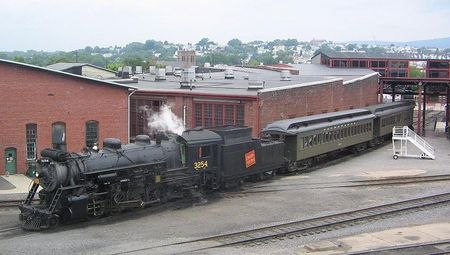
Steam engine and two passenger cars at Steamtown National Historic Site, August 2005. Background buildings are (left to right) locomotive repair shops, 1902/1937 roundhouse section, and museum.
Photo by Ruhrfisch via Wikipedia.
An article about Steamtown National Historic Site in today’s [Scranton, PA] Times-Tribune caught my eye this morning. I’ve known for a long time that the famous railroad museum/heritage park is troubled, but the article detailed problems a lot more serious than I had been aware.
Chronic budget shortfalls have prevented the park from performing adequate maintenance and making improvements badly needed to bring attractions and services to the level of visitor expectations. Too many people are avoiding Steamtown. Too many who go there are leaving disappointed.
Dismayed and frustrated by these trends, some critics of Steamtown’s management are arguing that only privatization, whether partial or sweeping, can provide the capital and expertise needed to upgrade the park’s resources, improve the park’s image, and restore attendance to healthy levels.
The numbers tell the story. Last year only 70,726 people visited Steamtown. Though a slight increase from the year before, this tally is nearly 141,000 fewer than the 211,553 who showed up for the park’s inaugural year. Attendance fell below 100,000 in 2005 and hasn’t revisited that level since.
Back in 1986 when Steamtown was created, many critics complained that the park was a pork barrel project, had too many Canadian locomotives, and had other serious flaws. Regardless of these criticisms, most people – especially local tourism interests -- believed that the park would attract at least several hundred thousands visitors a year for the indefinite future. After all, railroad history and equipment are broadly appealing, Steamtown’s planners envisioned appealing exhibits and activities, and a big share of the U.S. population lives within a day’s drive of the park, which is situated in northeastern Pennsylvania close to densely populated Megalopolis.
The park opened to great fanfare in 1995, and things looked pretty good for a while. Now there is weeping and wailing. What went wrong?
To hear Steamtown’s harshest critics tell it, mismanagement is the central reason that the park hasn’t lived up to expectations. Railfan Donald L. Pevsner, a transportation lawyer and self-billed consumer advocate, has been fascinated – and frustrated – with Steamtown for a long, long time. In fact, he is quite familiar with the provenance of the railroading equipment gathered at Steamtown (tracing all the way back to the original collection at Bellows Falls, Vermont) as well as the key managerial issues and concerns at the park .
Pevsner insists that a disturbingly large of the estimated $176 million spent at Steamtown over the past 22 years has been wasted or misdirected. According to the Times-Tribune article, Pevsner points to three main problems:
■ Deterioration of dozens of locomotives, passenger cars and other pieces that are part of the site’s static collection. “They have been basically allowed to rot into the ground. ... A lot of visitors described it as a junkyard,” [Pevsner] said.
■ Minimal locomotive restoration work. The park’s state-of-the-art locomotive shop is a “near-moribund shadow” of what was originally envisioned.”
■ Reductions in the number and frequency of steam-powered mainline passenger excursions. At one time, Steamtown operated two excursions daily during the peak season; it is running a total of 20 in 2008, including just one each to Delaware Water Gap and Nicholson.
Another of Steamtown’s prominent critics is New Yorker Ross E. Rowland, Jr., a rail enthusiast whose involvement with steam powered rail projects goes back more than 40 years. Like Mr. Pevsner, Rowland is an unabashed supporter of privatization, at the very least for the mainline rail excursion part of the Steamtown operation.
Mr. Rowland argues that the National Park Service is incapable of managing Steamtown the way it should because the agency is suffocated by rules and severely lacking in imagination. Accordingly, the only sure way to put Steamtown back on the road to recovery is to turn it into a true business venture. There’s no basic reason, he says, why Steamtown could not attract a quarter million visitors a year if operation of the site were turned over to a proven commercial steam powered tourist railroad operator.
Steamtown superintendent Harold H. “Kip” Hagen, Jr. disagrees that Steamtown’s problems are as serious as critics contend, and argues that the park’s problems can be corrected in due time using taxpayer money and without resorting to an infusion of cash and managerial/promotional talent from the private sector.
Superintendent Hagen and other National Park Service officials also point out that the park was founded to tell the story of U.S. mainline steam railroading, not to operate tourist excursions in a theme park atmosphere. That said, Steamtown will offer a few more excursions next year and is developing a new business plan for the mainline excursion component of the park’s operation.
If you want to see what it’s like to ride a train at Steamtown, have a look at the video clip at this site.
Story Categories:
A copy of National Parks Traveler's financial statements may be obtained by sending a stamped, self-addressed envelope to: National Parks Traveler, P.O. Box 980452, Park City, Utah 84098. National Parks Traveler was formed in the state of Utah for the purpose of informing and educating about national parks and protected areas.
Residents of the following states may obtain a copy of our financial and additional information as stated below:
- Florida: A COPY OF THE OFFICIAL REGISTRATION AND FINANCIAL INFORMATION FOR NATIONAL PARKS TRAVELER, (REGISTRATION NO. CH 51659), MAY BE OBTAINED FROM THE DIVISION OF CONSUMER SERVICES BY CALLING 800-435-7352 OR VISITING THEIR WEBSITE. REGISTRATION DOES NOT IMPLY ENDORSEMENT, APPROVAL, OR RECOMMENDATION BY THE STATE.
- Georgia: A full and fair description of the programs and financial statement summary of National Parks Traveler is available upon request at the office and phone number indicated above.
- Maryland: Documents and information submitted under the Maryland Solicitations Act are also available, for the cost of postage and copies, from the Secretary of State, State House, Annapolis, MD 21401 (410-974-5534).
- North Carolina: Financial information about this organization and a copy of its license are available from the State Solicitation Licensing Branch at 888-830-4989 or 919-807-2214. The license is not an endorsement by the State.
- Pennsylvania: The official registration and financial information of National Parks Traveler may be obtained from the Pennsylvania Department of State by calling 800-732-0999. Registration does not imply endorsement.
- Virginia: Financial statements are available from the Virginia Department of Agriculture and Consumer Services, 102 Governor Street, Richmond, Virginia 23219.
- Washington: National Parks Traveler is registered with Washington State’s Charities Program as required by law and additional information is available by calling 800-332-4483 or visiting www.sos.wa.gov/charities, or on file at Charities Division, Office of the Secretary of State, State of Washington, Olympia, WA 98504.


National parks and their natural resources belong to you. The National Parks Traveler works to ensure you know how these essential places are being cared for.
Sign Up For Our Weekly Newsletter
Unsubscribe at any time.
INN Member

The easiest way to explore RV-friendly National Park campgrounds.

Here’s the definitive guide to National Park System campgrounds where RVers can park their rigs.
Our app is packed with RVing- specific details on more than 250 campgrounds in more than 70 national parks.
You’ll also find stories about RVing in the parks, tips helpful if you’ve just recently become an RVer, and useful planning suggestions.


Comments
As a Steamtown volunteer, I posted the following comment to the article in the Scranton Times:
Mr. Singleton:
It was some days ago that I learned of your article on Steamtown through an announcement of its impending publication posted on a website devoted to the railroad preservation community interests, Rypn.org by Ross Rowland, one of the “critics” airing their views in the article. I expected that if Mr. Rowland was “hyping” the article in advance, its tenor or conclusions would match his well known negative attitude toward Steamtown.
Whatever the conclusions, I would have expected that you would have vetted your sources better. Unfortunately, you did not. Unlike those critics, I have been an active volunteer at Steamtown since 1995 in various capacities, but primarily in train and engine service. From that lasting affiliation, I know Steamtown very well, and both its positive and negative attributes. Because of that, I think we should examine a few positive aspects of Steamtown and the motivations and qualifications of its critics.
First, let consider three positive aspects of Steamtown.
First, Steamtown is still operating long distance excursions when others, most notably the Grand Canyon Railroad (who just shut down their steam operations this month) and the Ohio Central have given up on regularly scheduled steam excursions. The only exception to this rule has been the new excursions on the nearby Reading and Northern Railroad, who returned their No. 425 to service this year. In a testament to the difficulties of operating Steam, the 425 was inactive for over a decade and they have announced no plans to restore their other and larger locomotive- the Reading 2102 (a sister to Steamtown’s 2124) to service.
Secondly, Steamtown is currently and successfully operating excursions on the Canadian Pacific Railroad, no small accomplishment. Most large, publicly owned railroads want nothing to do with public excursions (especially steam), as they perceive enormous operational and legal risks in order to be associated with passengers and older equipment. These concerns have sidelined numerous locomotives in recent years and caused the end of the Norfolk Southern’s steam program in 1994.
Third, Steamtown has managed to attract and retain one of the most active, vigorous and dedicated volunteer groups in the country. Some volunteers now have over twenty years of service and one provided over 10,000 hours of volunteer service.
Finally let’s examine the qualifications of two of your “critics”, Mr. Donald L. Pevsner and Ross Rowland.
Mr. Pevsner is indeed a “transportation lawyer” but his legal background appears to be confined to commercial aviation. There is no suggestion that he has any special knowledge of railroading in general, or heritage operations in particular other than as an author of opinion pieces. It’s quite a different matter to fly an aircraft in the public airspace than it is to operate a train over privately owned rights-of-way.
Secondly, while Ross Rowland has operated showcase operations such as the American Freedom train, inside the preservation community and in the railroad industry in general, he is something of a pariah. I have personally spoken to a retired railroad manager who was a trainmaster on a railroad Ross operated on in the 1960’s who expressed concerns over Ross’ ability to subordinate his showmanship to the “prime directive” of railroading-safety.
With the possible exception of some limited success in the late 1960’s, (now a lifetime ago) Ross has never been able to operate steam on a sustained basis. Typical of his operations were trips run in the late 1990’s on New Jersey Transit from Port Jervis to Hoboken. The trips were run until the locomotive; former C&O No. 614 needed the heavy mechanical work all steam engines require. Unable to fund that rehabilitation, he had the locomotive taken to the Reading & Northern’s Port Clinton headquarters where it remains today parked and cold in an inoperative condition.
I suspect part of his campaign against Steamtown is in part due to his inability to reach an agreement to move that locomotive to Steamtown. It’s also clear that he regards Steamtown more as an amusement park than a government operated historic site and doesn’t seem to understand that there are mission-driven constraints on the nature and extent of the operation.
Dear Superheater,
As much as I understand your points, I must argue. Although Pevsner and Rowland may be all talk and don't really know what they're talking about, their points are true. I've been a loyal fan of Steamtown since its dedication in 1995 and I know that, despite the amount of money the government pours into it and the number of volunteers that give up countless hours to it, Steamtown hasn't really changed at all since its creation. I know that money doesn't go that far and that the NPS is doing their best, but with all due respect, the National Park Service could do better.
First of all, if Steamtown is trying to tell the story of railroading in the US, why are the only two operational locomotives at the site Canadian. Wouldn't you think to story of railroading would be better told with American locomotives, especially some of the more famous ones at Steamtown, like Nickel Plate #759 and Reading #2124?
Secondly, if Steamtown only exists to tell that story, a 15 minute train ride around the site full of rusting and rotting rolling stock doesn't portray that story very well. Railroads in their day took care of their rolling stock; if it needed repair, it got it; if it needed new paint, it got it. I know something on that scale isn't cheap, but in the long run, it would do a lot for Steamtown. In relation to mainline excursions, I found the one comment in the other article about Steamtown existing to tell the story of railroading, not for excursions, ridiculous. With the types of engines that Steamtown uses, the story would be better told out on the mainline. Part of the story of railroading are those long excursions. Throughout this entire country, if a railroading museum has live steam or diesel, they have a good expanse of track to run it on.
Thirdly, since Steamtown is given $5.2 million a year by the government, is it really that hard to save some of it and restore another American locomotive? Think about it. Boston & Maine #3713 costs about 1.3 million to restore and she's not very well known Considering the fame of Nickel Plate #765 and the amount of attention Ohio Central is getting for the restoration of Nickel Plate #763, don't you think their would be more support, donations and volunteers, and in the long run be worth it to restore Nickel Plate #759? She alone would bring a whole lot more people to Steamtown. The only thing really wrong with #759 is that she needs new flues and tubes. You could probably get a couple of those off of NKP #757 in Strasburg. The Railroad Museum of Pennsylvania has no intentions of restoring her; I'm pretty sure they wouldn't mind a few things being removed. That alone would bring so many more people to Steamtown, money would soon not be an issue anymore.
Fourthly, why does Steamtown always submit to other railroads in the area. You're a Federal Park; I think the Federal Government has some influence. Take, for example, the mainline from Scranton north to Binghamton and the wye at Norfolk Southern's Portland yard. You would think the the NPS would really be pushing to use the wye. I know my steam engines and I know running tender-first up a grade like the Pocono Summit grade does more harm than good for a steam engine. It wouldn't even cost that much for the government to step in and say to Canadian Pacific or Norfolk Southern, "You're going to let Steamtown do these things." Especially with Canadian Pacific. After all, Steamtown did give Canada its National Locomotive, Empress 2816.
In conclusion, I would just like to reiterate that I do understand where you are coming from. Money doesn't grow on trees, and especially for an operation the size of Steamtown, every penny has to be pinched. I just feel that in the long run, things would be a lot better for Steamtown if some things were changed
Thank You
Don't you realize that tourism brings cash? One of the best things for an economy is tourism! If Strasburg can do it succesfully, why not steamtown? Sure the Strasburg Railroad is nowhere near the milage that is covered on Steamtown's excursions, but yet they have multiple operating steam locomotives that they run regularly (as opposed to the whopping two that steamtown has) and have the resources to maintain them, unlike Steamtown! Straburg is just a farm town! If you can get people to speck on the map that is Strasburg (no offense to any of the residents) you can get people to come to Scranton! The difference between Steamtown and Strasburg is that Strasburg actually has the forsight to take care of their equipment! Strasburg is a perfect example of a shortline steam railroad. Where's our example of a big steam mainline railroad? Steamtown is not a junkyard, but an opportunity! I swear to God if I had the means, I'd buy that "rust belt" and show you a thing or two about how a main line steam railroad can attract visitors! Look at the electric city trolly museum! Look at the Neveda Northern! All privately owned and SUCCESFUL! The only problem Steamtown has is the government! There was a movie quote, what was it now..."If you build it, they will come."
My family and I go out of our way to ride in steam powered trains. For example, we never miss the Durango Silverton line when passing through Colorado. It is like stepping back in time, just magical. Bottom line: If my family can't ride the train -any train- for a awesome excursion, we are not going to make the trip. If privatization would bring more rides for families, then in this particular case, I am all for it. Looking at old trains is one thing, but riding the train is the total experience.
I didn't realize it was so bad. I visited there a couple of years ago, and didn't feel disappointed. Yes, I was disappointed there weren't more visitors, but I didn't visit during the peak season anyway.
I do disagree with Beamis, however, that Scranton doesn't deserve an attraction simply because it's an economically depressed area. We shouldn't abandon parts of the country that aren't doing well simply because the money is elsewhere.
Just because it's not convenient doesn't mean it's not important.
============================================================
My travels through the National Park System: americaincontext.com
Superheater;
I have a considerable affiliation with your interest in historical steam and railroad operations, and empathy for the preservation effort you support. I cringe a bit, that so many aspects of our 'progress' 'discredit' formerly outstanding technologies.
I know what a "superheater" is & does: I am a (turbine) steam plant operator ... and nuclear power plant operator, and submariner. The hull of my Thresher-class boat, the USS Drum SSN 677 lies tied in the Sacramento River at Mare Island (the now-closed Navy base, where I attended nuclear power school) awaiting funds to turn it into a museum and sole surviving example of the quiet machines that substantially enabled us to retire the Soviet Union. I imagine it's a forlorn project.
I like that piston steam can run on a campfire. That valve-boxes can be fabricated with a hacksaw & file. At the remote resort where I live, we pulled a vertical boiler out of a septic tank: it now decorates the yard of the cabin next door. I grew up with the giant stumps logged by 5 or 10 horsepower steam donkeys. My grandfather stands with a crew of dozens on one.
So ... yeah, I have a pretty good idea where you're coming from, why you do what you do, and what you get out of it.
Unfortunately, it may well be that the US National Park System/Service was not really the organization that can best see to our steam railroad heritage. My operational suspicion is, we've saddled the laudable idea of natural-wonder & King's-forest Parks with too many follow-on functionalities, at which it is basically ill-suited.
Right now, we are dancing around, anxious to restart the 19% of our national refinery capacity that was shut down as hurricane Ike passed over. This is likely a foretaste of an increasingly common predicament ... hoping we don't start seeing NO GAS signs cropping up, or (groan) prices breaking $5 ... etc.
I'm not sticking my economic neck out anywhere these days, and I expect coming Presidents & Congress' are going to be following suit. In this climate, people with a passion such as yours will find their efforts complicated by stark economic realities.
... So if it's not going to be the NPS, how else might Steamtown hold it together?
Hey, you're looking at a new Vice President who was born in Scranton -- so don't expect that Steamtown will wither on the vine and die. Eight more years to get its act together...
I've previously visited this Park, and while I enjoyed my experience here - I also felt like it missed the mark.
Railroads have unquestionably had a profound effect on the history, culture, and development of this Nation. This story definitely seems like it should be told in part through the National Park System. However, unlike many other stories in this Nation's history, such as the story of Jazz in New Orleans, the Industrial Revolution in Lowell, or Lewis & Clark at Fort Clatsop - I don't know that there is any one "essential place" to this story.
Where Steamtown misses the mark is that it tells the story of railroading in Scranton, Pennsylvania in exquisite detail - it is nevertheless the story of railroading in Scranton, Pennsylvania.... not exactly life-changing or Earth-shattering stuff.
I think there is a proper role for a *true* "Railroading National Historic Site" in the National Park System, and I don't know that any place has a necessarily better claim to being the most-appropriate place for a Railroading NHS than Scranton does. O.k., maybe Promontory, Utah and the existing Golden Spike NHS - but if that place told the story of railroading in terms of Westward Expansion and the Trans-Continental Railroad and another place told the story of Railroading in the context of Urban Development on the Eastern Seabord, I don't think that would necessarily be overkill.
Thus, I am somewhat sympathetic to the levied charge that the existing management of Steamtown NHS lacks imagination. I think it would only take a little imagination to extend the virtual boundaries of Steamtown beyond the story of Scranton, PA and tell a truly National story of railroading and the development of country - a story that might have much broader appeal.
Hah! You could be describing the mortgage industry as well! Ironic that there's not much outcry over bailing about big banks who screw up but there is over relatively small things like Steamtown (then again, it's not like STEAM has much of an impact on the national economy)
Anonymous said;
Just to clarify here, our civilization would promptly collapse, without steam. Steam drives our economy, our industry, and our military.
All fossil-fuel electrical generating plants are steam plants. All nuclear power plants are steam plants. Industrial plants make profound use of steam & steam power. Shipping and the Navy are steamers.
Steam not only survives, but you and all the rest of us are utterly dependent upon it.
True, piston steam engines are now rare. Steam trains are retired. But truth be told, it was perhaps more the horrendous belching clouds of wretched-filthy smoke coming from locomotives, than the inefficiency of piston-steam, that did them in. (Plus of course the general collapse of railroads.)
Steam radiant heat no longer dominates in homes & buildings ... but stand by: you may once again hear the clanking of steam pipes, and park your butt on a nice radiator under the window.
Steam is steam, and it's a good thing to know about.
Mr. Clayton,
I was using STEAM in reference to Steamtown NHS, although the correct alpha code is STEA (mea cupla). I am fully aware of steam (ie - water in its gaseous state) and its importance to the economy since I live in TVA (http://en.wikipedia.org/wiki/Tennessee_Valley_Authority) country and my entire life owes itself to steam-generated electricity.
I've been an avid railroad enthusiast since I was able to walk, having grown up along the maintenance feeder siding of the main AT&SF yard in the country. I'm also a member of the NMRA, have an expansive working 1920's-50's layout in my home which, spans 3 rooms (delivers burgers, hot dogs, chips, etc. around the house) and have 2 of my boys involved as modelers now as well. Like Marylander, I never pass up the opportunity to ride the Durango to Silverton line, the Grand Canyon Railway (in summer only, when the steamers are in use), along with many other scenic, historic, and fascinating "tourist" lines across the country. But the idea that everyone with an interest in the history of railroading in America would flock to Scranton was a bit naive. Certainly, there are a few million of us in the nation who hold the steam era near and dear to our hearts, and consider this the Golden Age of railroading, but there just as assuredly aren't anywhere NEAR enough of us who would care to make Scranton an annual destination and throw down enough cash to support a park centered on the history of a local faction of the national scope. This ain't like another out of the way destination of even smaller stature, Cooperstown NY, where you have literally millions of baseball die-hards willing to migrate each season (and out-of-season for that matter) to watch the well-marketed Little League World Series, the ex-Hall of Fame Game and the annual induction ceremonies. Personally, a railroading-centered vacation would have to encompass WAY more than hours of driving to a single location for one lousy encounter, and there just isn't the plethora of other railroading opportunities along the way coming from most any other direction to make that type of a trip attractive. Even at Cooperstown, you can manage to take in games in Detroit, Cleveland, Philly, NY, Pittsburgh, etc. such that you can help justify the investment of time heading out to "middle of nowhere NY".
That said, disposing of the inventory shouldn't be a major concern. There are numerous privately funded groups across the nation who would be more than happy to acquire vintage steam locomotives and rolling stock. Local museums, such as the Illinois Railway Museum in Union, IL. survive on showcasing these icons of the American expansion movement, run special excursions on them, and have a "moving exhibit" available for viewing every day of the year. Trust me; the hardware wouldn't go the scrap heap.
it's not like STEAM has much of an impact on the national economy
I think that was another bit of tongue-in-cheek Ted. Nobody could possibly possess a level of ignorance that great to make that statement in all sincerity.
ON PARK ORGANIZATION CODE LETTERS:
NPS people should be wary of using any Park Org Code in any discussion of any national park. Not only is it hopeless jargon, but it trivializes the meaning of the name of the park. Fortunately, the National Parks have names that actually mean something. Many National Wildlife Refuges and National Forests have names that have nothing to do with what the resource is. Parks should be proud of their names, and NPS people should use the name.
The US Fish and Wildlife Service also uses 4-letter ORG codes just like the National Park Service. See what is happening to the Arctic National Wildlife Refuge since oil development advocates realized what a benefit it would be NEVER to have to say "wildlife" or "refuge" whenever they spoke of the Arctic NWR. So: they reduced it to the ORG code they had been hearing from FWS bureaucrats who would call the refuge "ANWR" when they met and in their correspondence.
Now, mainstream media have picked that usage up. So far, you don't hear politicians or people in the media say "YELL" when referring to Yellowstone NP, or "GRCA" when speaking about Grand Canyon NP, or "YOSE" when speaking about Yosemite NP: this is further evidence that the use of "ANWR" is done deliberately to demean a majestic national wildlife refuge. NPS people should take note, and never use ORG codes in place of the names Congress gave units of the National Park System.
My error Beamis. The annual Little League tournament games at Cooperstown are indeed not the "official" LLWS finals. More of a preliiminary finals would be accurate.
Ah, good 'ol Monday mornings, when the fingers and what little brain I have remaining aren't coordinating too well.
Ok,
The story on Steamtown is this, the much of the place of the park is historic and worth protecting but "sort off" on a local and regional scope. However, it was the rail yard and headquatersfor one of the first lines in the USA and is one of the best examples of "age of steam".
The park should be using this to there advanage and have focus general on the national history of steam engines not a local one.
The park might also do better as a site National Historic Site run much as the one in Newport is run, as an affliated site run by National Railway Historical Society with an agreement with the National Trust for Historic Preservation to give its title.
However, I do think that Beamis does make some good points, but also think that economic development is not a bad thing for a park to do and that a compromise could be reached.
STEA is another example of "build it and they will come" mentality compounded by Rust Belt welfare handed out where commercial capital will not go. In the bit of research I've done on this issue over the last day or two, it seems that STEA was half of the anchor designed to revitalize downtown Scranton. The other half was the Mall at Steamtown, funded by UDAG (federal money) grants, state grants, the PA state employees pension fund, and the IBEW (electrical union) pension fund. Apparently not a bank dollar in sight. The Mall of Steamtown's history page indicates projections for visits to STEA at the time the mall was developed (about 1995) was 500,000. Here we are ten years later and visitation is about 70,000, and the Mall at Steamtown is facing loss of several tenants either through bankruptcy or moves to better markets in the suburbs. This is not good for the park regardless of ownership/management.
I recall back in the mid '80s that the Baltimore and Ohio Railroad Museum in Baltimore, the cradle of American railroading, was a potential competitor with the STEA concept. For whatever reasons, the B&O's extraordinary collection of American railroad stock and its significant history were not enough to overcome that of what's been described as a "third rate collection of mostly Canadian stock" and a very narrow focus on the steam story. I suspect it's politics at it worst. Regardless, today the B&O Museum is a remarkable success story with visits of about 250,000 per year. A comparative history of the development of these two sites over the past 25 years would make a great MA thesis, and probably answer many of the questions raised in this post/thread.
FWIW I think STEA is a prime candidate for deauthorization if we want to go by NPS guidelines and put political expediency aside. It would make a fine state or local museum with a concessioner or non-profit operating the excursions. A potential model for this is Cuyahoga Valley National Park (Ohio) where a cooperating entity (Cuyahoga Valley Scenic Railroad) operates excursion on Service-owned track. Another model may be San Francisco Maritime NHP where innovative methods and community involvement have resulted in the restoration and operation of several vessels.
As a former Service employee, I feel for the park staff, knowing that they are doing their best under really tough circumstances. They are well aware that many of their colleagues think the $172 million spent at STEA could have helped the NPS gems crumbling under the impact of millions of visitors. All of this reminds me of Ronald Reagan's response when he signed the Cumberland Island National Seashore's wilderness designation back in the early '80s. Basically it was, "Don't even think about sending me something this absurd again." He signed the politically charged legislation knowing it would be a land management nightmare. Sure enough, it has been a legal and management quagmire from the beginning, and will remain so until 2100 when - let us hope - all the CUIS life estates and their inevitable extensions expire. STEA's future seems almost as troubled, given their complex, costly responsibilities, diminishing resources, and limited alternatives.
Don't forget that decades ago Steamtown was a private interest in Vermont (I remember hearing the ads on TV when I was a kid). The original owner (er, perhaps I mean primary financial supporter) died in the 60's and the Vermont park went out of business. So would Steamtown survive today as a private concern again? I am actually a fan of separating the NPS from the federal government (turning it into some sort of an NGO), and that means it would have to survive as a self-supporting enterprise.
Beamis, to clarify my earlier comment, I wasn't making a comment as to whether pork-barrel projects are worthwhile or not, or whether the government (and thereby the taxpayers) should spend millions (or billions) in ill-considered economic development projects. I'm simply stating that the NPS shouldn't move sites simply because they're in an economically depressed area, which I got from the tone of your earlier post.
========================================
My travels through the National Park System: americaincontext.com
Beamis is right when he says
but the idea of turning it into a park and museum was not the bad Idea. The bad idea was making a national park run with taxpayers money. It should have been a partnership run with the help of NPS much like the National Monument in Oklahoma City is run.
CLARIFYING RESPONSES to RoadRanger; to Beamis; to ChrisBugsyShallFall:
-- to RoadRanger: Your Baltimore idea as the better site, of course misses the point that the only reason NPS got a Steamtown is because the congressman was from Scranton, high on the Appropriations Committee, and was looking for something to do for Scranton. There was no study, to determine either if there was a better collection elsewhere, or what a feasible protection strategy could or should be. In fact, there was no legislation, per se, because it became law via an insert into an APPROPRIATIONS bill, not a normal legislative "authorization."
You also indulge in a little political naivete with your Reagan Quote on Cumberland Wilderness , "Don't even think about sending me something this absurd again." Reagan must have know Cumberland was one-of-a-kind because it was the legacy NPS project for former President Jimmy Carter. It is true that some Presidents get more than one legacy project, but the point is they often do not fit any pattern. Look, for example, of FDR's St. Paul's Church near the Bronx (a project of his mother's, and actually enacted after Roosevelt's death) and the Vanderbilt mansion in Hyde Park, owned by a friend of Roosevelt's who needed to unload it: neither area is nationally significant or nationally distinctive. So Reagan was just pretending he had virtue, when he knew in advance Cumberland Island was one of a kind. Carter just wanted the NPS to figure out a way to save the place, but under Reagan no one was going to go in and acquire all the inholding land parcels, as Roosevelt so often did.
And RoadRanger, the Real Politik missing in your comment about the terrific RR managed through agreement with
Cuyahoga Valley National Park is once again, Cuyahoga is one-of-a-kind, because Republican Congressman Ralph Regula has provided them all the money they needed. These are all sweet insights, but naive because first you need to consider: where's the money??
RoadRanger is right about the staff at Steamtown: the superintendent is once of the nicest and quickest project manager in the NPS. However, he is not an economic development specialist, and not a tourism or heritage area development specialist, which they needed about 10 years ago. Within the limited scope of work, and the now-limited available money, this superintendent cannot do more for Scranton or Steamtown. He would be a brilliant superintendent at a different park, and Steamtown is lucky to have him.
-- Beamis is wrong to blame Bud Shuster (R-PA) for Steamtown. Steamtown is the creation of ANOTHER Republican from Pennsylvania, Congressman Joe McCade of Scranton. The deal was put together by his congressional staffer, Debbie Weatherly, of Scranton herself (who as a result of this Experience was moved by McDade to become the lead Republican congressional staffer in the Appropriations subcommittee that funds national parks, the Arts Endowment, Wildlife Refuges, National Forests, etc), and aided by another congressional staffer from Sranton, who was on the Full Committee of Appropriations but actually working for McDade. Weatherly has been enormously important to Steamtown, all the more interesting because of her dominance of the NPS budget nationwide for the past 12 years. All the money that has gone to Steamtown was apppropriated by McDade. At one point, he was actually scheduled to become the Chairman of the Full Committee of Appropriations, but the threat of an ethics investigation worried Gingrich, who made Bob Livingston (R of LA) chairman instead, in order to delay or forestall the investigation. The first time the National Park Service said anything nice about Steamtown was when Ms. Weatherly and the Republicans moved into the Majority and Weatherly took over the NPS budget. The Deputy NPS Director at the time, formerly head of the Denver Service Center, would introduce Ms. Weatherly to room-fulls of park superintendents and "assure" them that Ms. Weatherly was doing a great job and Steamtown was completely legit. We all thought he'd be turned into sushi if he said anything else. All this is a lesson in the ethics of the Republican Party. Although McDade had to resign, Ms. Weatherly is still there, although now in the Minority.
But Beamis is wrong, most of all, to suggest that the money that went to Steamtown would have gone to some other worthy NPS project elsewhere if it had not gone to Steamtown.
OVERWHELMINGLY, money from "pork" is only available for what the congressman wants.
It would not go back into the general NPS coffers! WAKE UP everybody! It would probably would have disappeared into a different project in Scranton.
(Look at what happened to the famous "bridge to nowhere" in Alaska: Governor Palin still got ALL the money, but just for SOME OTHER PORK PROJECT of hers! I am always dazzled by these assertions that if you take the money from "pork" it would go to something the speaker thinks is more legit. Well, the fact is, the Constitution makes the money bill originate in the Congress, not the Presidency. There are good reasons for the Constitution to make the congress, not the President, in charge of the money. But the point is: You cannot solve the problem of "pork" by saying you are just against the whole "category" of spending via congressional initiative. SOME congressional projects are good. Some are dogs. Each one needs to be evaluated on its own merits. We need transparency. We need evaluation. That is what the new Appropriations Chairman says we will have. We will see. But when McDade and Weatherly did Steamtown, they did it with no oversight, and later when the parks Authorization subcommittee chairman (D-Minn) tried to put the brakes on it, he barely accomplished anything. People like McDade and Weatherly should be made to operate in the sunshine.
-- to Chris BugsyShallFall, I would only observe that Oklahoma City should be no model of anything. The NPS has no real accountability over that site, because once again the money just comes from congressional initiative against any common sense or actual oversight. Again, unlike Steamtown and Cumberland Is, Oklahoma City has had all the money it needs for what it needed to do. Ditto, Cuyahoga.
A better model is a heritage area in which the NPS should approve a plan based on what will be protected and interpreted and how it will be done (strategy), and should then fund the area based on performance. It should be part of a regional tourism strategy heavily leveraged by local governments, the private sector and the State.
As several point out in this thread, of course, the truth is the local business community either does not support or cannot support this stragegy sufficently. And the idea that tourists would drive over from NYC on the newly-constructed Interstate HyWy across New Jersey, itself built in order to CREATE economic development in northern Pennsylvania, not RESPOND to development, did not revive Steamtown OR Scranton.
The trains are impressive. But people like to see things MOVE. Perhaps they would like to see the countryside, if real excursions were available. No static exhibit of trains will attract anyone to Scranton. The notion that the trains would make a shopping mall viable is only one shade better than the Sevens-Palin bridge-to-nowhere.
I think the reason this particular brand of politicians get away with this sort of thing is, ultimately, they and their colleagues of the same stripe do not really care about national parks, or an effective transportation system either. We have had in History great Republicans like T. Roosevelt who believed in National Parks, or more recently great Republicans such as John Chafee who had the power to get whatever he wanted, but would not support "dogs" no matter what benefit to some donor. We need elected officials in BOTH parties who believe in parks and historic preservation, not these cynics we have today.
A “thank you” to Anonymous for providing us with some real meat in the clarifying memo, and reinforcing how critical it is to follow the money if you want the real answers. Re the Baltimore collection, my point was not to study the origins, but to examine the evolution of the sites over the past 25 years. Granted, there are some obvious differences between them, but I’d like to know why the Baltimore museum – operations and management, whatever – made such a remarkable recovery. Re Reagan and Cumberland Island, the seashore was established in 1972 and operating before Carter was in office, so wilderness was the legacy issue. I can’t imagine Reagan liking any park legislation and I don’t know who drafted the letter for his signature, but they certainly understood the consequences. It may have been a noble effort in the ‘70s and early ‘80s to support a “wilderness” designation for Cumberland Island, but it certainly wasn’t realistic. Following the money and power will tell us why the NPS lost that one, too.
Anonymous raises an interesting point with legacy parks. In a single term, Jimmy Carter was one of the lucky presidents to get two parks for his home state, Chattahoochee River National Recreation Area, and Martin Luther King National Historic Site, and much of Alaska for all of us. He has quite a legacy when it comes to preservation.
Dear RoadRanger
-- thanks for clarifying the point about Baltimore. Yours is a very important point. Not enough is known about when a site or museum is self-sustainable, and why not when it is not. Baltimore is an interesting overall case, because it has more successful tourism than the much larger, and presumably higher-quality (re: # of nationally significant sites) Philadelphia. But the issues in Gettysburg and Valley Forge and many others will continue to plague --ASSUMING WE DEMAND SITES TO BE ECONOMICALLY SUSTAINABLE RATHER THAN SEEING FEDERAL APPROPRIATIONS -- until real and predictive feasibility studies can be done as a matter of course.
-- yes, you are right about Cumberland Is Wilderness, and right about Carter. I think Reagan and the NPS should have made a better solution at Cumberland Is, in the same way NPS followed up on Ickies and FDR and made parks of the 30's and 40's work. And of course, the Alaska Lands Act by carter, and his national monuments is the largest conservation action by any American President.
-- I don't think MLK site is his legacy, though, any more than other parks created during his time were his. Most were really established by Phil Burton.
thanks for this dialog.
Anonymous,
That is a much better Idea
More correctly, I should have said all revenue bills originate in the House of Representatives.
HOWEVER: Appropriations bills must be enacted by Congress in the Constitution. Can you imagination if Congress NEVER interfered with appropriations proposals from Congress? Sen. McCain says he wants no congressional earmarks, BUT DO YOU REALLY WANT CONGRESS JUST TO RUBBER STAMP THE APPROPRIATION REQUESTS OF THE PRESIDENT, no matter who she/he is?? Ruling out any change by Congress to a President's budget cannot be a good idea.
The point is: The idea of a congressional earmark itself is not the problem. The problem is either the MERIT of the individual earmark, and the TRANSPARENCY of the earmark. The additional problem with Steamtown, which had problems both with transparency and merit, was that there was no NPS STUDY, and no REVIEW AND APPROVAL BY THE AUTHORIZING COMMITTEE OF CONGRESS.