
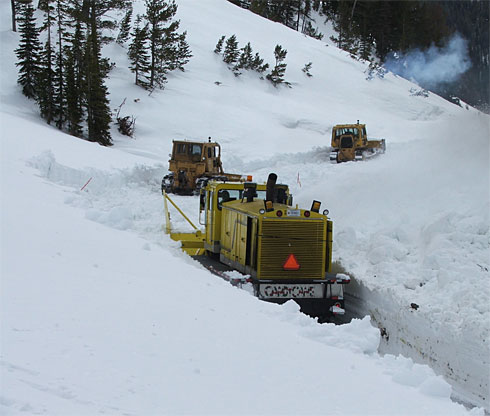
Why is the National Park Service negotiating the opening of Sylvan Pass in the winter? NPS Photo.
Yellowstone National Park officials met earlier this week with several representatives from Wyoming to discuss the options at their disposal for bombing snow-covered mountain slopes in our nation’s first national park.
Why?
To keep it clear of avalanche danger for the handful of snowmobiles and snowcoaches that enter the park through Sylvan Pass on the park’s east side each day during the winter season.
Among the hardware options discussed were a new 105 mm howitzer, a series of permanently mounted “Gazex” propane-powered fireball throwers, dropping explosive charges from a helicopter by hand, and installing a "trolley" system of cables across avalanche-prone ridges where explosives could be dropped remotely.
After 10 years of study (and at a cost of more than $10 million!), the National Park Service finally released its plan in September regarding how to manage use of Yellowstone during the winter season. In the plan, the Park Service decided to discontinue its avalanche control program and close the park’s East Entrance, which crosses Sylvan Pass, to over-snow vehicles during the winter season.
The Park Service expressed valid concerns about the well-documented risk posed to park employees responsible for clearing the pass of avalanche danger as well as the unjustifiably high financial cost of maintaining the route to accommodate only a trickle of visitors in this cash-strapped park.
However, residents of Cody –which is located 53 miles east of Yellowstone’s East Entrance -- and Park County, Wyoming, successfully lobbied to force a change in the final Winter Use Record of Decision (ROD), issued in December. Instead of closing the pass in the winter, the ROD established a ‘Study Group’ made up of two Yellowstone officials and eight Wyoming representatives (all eight were proponents for keeping the pass open), to hammer out a ‘compromise’, due on June 1 of this year.
The goal of the group was not to determine if the pass should be open in winter, but how to provide continued motorized over snow access through the east entrance.
The Study Group also decided that portions of meetings would be closed to the public. The meetings earlier this week had three such closed-door sessions, marking the first time in more than 10 years of public involvement that the public has been excluded from a meeting about winter use in Yellowstone. The National Parks Conservation Association and others made repeated appeals to open all of the meetings to the public, but to no avail.
By excluding the public from these discussions, the Park Service ignored its own winter use ‘Public Participation Plan.’ Completed in 2005, the goal of this plan is: “…to build trust and transparency for the process, and, the hope is, build trust and transparency in the resulting winter use management actions. Every contact opportunity is an opportunity to build or lose trust.”
This tradition of open and public dialog has been undermined.
No other national park uses explosives to clear a route of avalanche danger for discretionary recreational use. The Park Service’s effort and expense clearing Sylvan Pass was made to accommodate, on average, 13 uses of this east park entrance per day each winter for the past three years.
In fact, as many visitors enter Yellowstone in one busy summer day as the entire 90-day winter season from this east entrance! Park administrators currently spend $200,000 annually on Sylvan Pass avalanche control, or an average of $170 per visitor, at a time when an analysis of Yellowstone's finances has demonstrated an annual shortfall of nearly $23 million.
Yet the least expensive option being discussed by the Study Group (the ‘enhanced howitzer’ option) would cost over $2.2 million to install and an additional $275,000 per year to operate, according to the Park Service’s own analysis. Finally, no less than 20 avalanche paths sit above the pass. Natural releases occur every season, and Park Service employees and equipment have been hit in the past.
Since 98 percent of visitors only use the Sylvan Pass east entrance in summer, its winter closure has little impact on Cody's local economy. The Wyoming Department of Revenue reports that Park County’s winter tax revenues and motel/hotel tax receipts have continued to grow between 2002 and 2006, despite declining use of the Sylvan entrance in winter.
A small committee behind closed doors should not decide these critical issues involving human lives and taxpayer dollars. These deliberations affect not just an American icon, but also all of us who share in the responsibility of protecting it for future generations. Closed meetings fly in the face of our Western tradition of open dialog. Decisions affecting our public lands and the use of the public funds demand opportunity for public participation.
Tim Stevens, based in Livingston, Montana, is the Yellowstone program manager of the National Parks Conservation Association’s Northern Rockies Regional Office.
Story Categories:
A copy of National Parks Traveler's financial statements may be obtained by sending a stamped, self-addressed envelope to: National Parks Traveler, P.O. Box 980452, Park City, Utah 84098. National Parks Traveler was formed in the state of Utah for the purpose of informing and educating about national parks and protected areas.
Residents of the following states may obtain a copy of our financial and additional information as stated below:
- Florida: A COPY OF THE OFFICIAL REGISTRATION AND FINANCIAL INFORMATION FOR NATIONAL PARKS TRAVELER, (REGISTRATION NO. CH 51659), MAY BE OBTAINED FROM THE DIVISION OF CONSUMER SERVICES BY CALLING 800-435-7352 OR VISITING THEIR WEBSITE. REGISTRATION DOES NOT IMPLY ENDORSEMENT, APPROVAL, OR RECOMMENDATION BY THE STATE.
- Georgia: A full and fair description of the programs and financial statement summary of National Parks Traveler is available upon request at the office and phone number indicated above.
- Maryland: Documents and information submitted under the Maryland Solicitations Act are also available, for the cost of postage and copies, from the Secretary of State, State House, Annapolis, MD 21401 (410-974-5534).
- North Carolina: Financial information about this organization and a copy of its license are available from the State Solicitation Licensing Branch at 888-830-4989 or 919-807-2214. The license is not an endorsement by the State.
- Pennsylvania: The official registration and financial information of National Parks Traveler may be obtained from the Pennsylvania Department of State by calling 800-732-0999. Registration does not imply endorsement.
- Virginia: Financial statements are available from the Virginia Department of Agriculture and Consumer Services, 102 Governor Street, Richmond, Virginia 23219.
- Washington: National Parks Traveler is registered with Washington State’s Charities Program as required by law and additional information is available by calling 800-332-4483 or visiting www.sos.wa.gov/charities, or on file at Charities Division, Office of the Secretary of State, State of Washington, Olympia, WA 98504.


National parks and their natural resources belong to you. The National Parks Traveler works to ensure you know how these essential places are being cared for.
Sign Up For Our Weekly Newsletter
Unsubscribe at any time.
INN Member

The easiest way to explore RV-friendly National Park campgrounds.

Here’s the definitive guide to National Park System campgrounds where RVers can park their rigs.
Our app is packed with RVing- specific details on more than 250 campgrounds in more than 70 national parks.
You’ll also find stories about RVing in the parks, tips helpful if you’ve just recently become an RVer, and useful planning suggestions.


Comments
budget cuts have hit everyone somewhere at sometime. it takes better times to support the minority. want better times? november is right around the corner, exercise your right.
Why do you believe that the vote in November could possibly make a difference on this particular issue?
The power brokers here are from both parties. The system keeps people out of it. Why support that system in hopes for a few bread crumbs and the hope that these things aren't decided behind closed doors? Tonight, Obama's solution was to broadcast health care discussions on C-SPAN. Give me a break.
We need to insist on a voice; now how does that happen? That's the question; the November vote is not an exercise in voice, it's the system's pacifier to keep us quiet every couple of years while people like this make the real policy decisions behind closed doors.
Jim Macdonald
The Magic of Yellowstone
Yellowstone Newspaper
Jim's Eclectic World
Looking for a voice in government then vote for: Obama! Want the war machine to exist...then it's McCain! Do you want a cleaner and greener environment then vote for: OBAMA!
And, the choice that Anonymous provides us is the false dilemma that so many people content with themselves.
That false dilemma is why the closed door meetings about Sylvan Pass, wars in far off places, and health care - decisions on which affect how you and I live are lives - happen without our input.
Jim Macdonald
The Magic of Yellowstone
Yellowstone Newspaper
Jim's Eclectic World
Jim, it's your generation that shouldn't give up hope for change. With Obama there is hope for change. Don't give up so easily!
It's because I haven't given up hope that I don't accept the false dilemma. It's the deepest form of cynicism to believe that other people (even those who claim they want to work from the ground up) need to be champions for us to give us a voice in the process. The sheer physics of this system, that one person represents 300,000,000 is enough to know that people cannot truly be represented by such a system. Each member of Congress represents how many people? Of course, snowmobile decisions are made by the few, and the many are reduced to signing canned petitions.
Hope has to lie somewhere else, and transparency is more than being televised by C-SPAN.
Political capitalism (by that, I mean a lot more than the cost of elections; I mean the use of "the people" as a commodity on which to wage large scale power) is just as dangerous as economic capitalism. If we really care about places we love, and I love Yellowstone unlike any place I have ever loved, then we must not give in to Obama v. Hillary or Obama v. McCain or this sense that our vote actually makes a difference.
Just look at what happens in Cody. People voted for a lot of those people; others are there as a byproduct of others who were voted for. Freudenthal's people are there, Bush's people are there, elected Wyoming officials are there. They are the "representatives." But, we know that they are not. They only represent people at the most abstract level; they only represent people because we have cynically given them this power.
It doesn't have to be this way; we can do better. One of the first steps is recognizing that the choice given to us is a false choice. We have other options available. We have more hope than most right now will permit us to believe.
Jim Macdonald
The Magic of Yellowstone
Yellowstone Newspaper
Jim's Eclectic World
Ok maybe I'm missing the point here, but didn't you say "portions of the meetings" would be closed to the public? I understand that to mean there were "portions of the meetings" that were also open to the public. I don't think you've really identified what exactly is wrong in this circumstance. I think the bigger issue here is why would the park service spend so much money (that it doesn't really have) to clear a pass that very few users access. That flies in the face of basic business sense. Forget that our rights have been infringed upon here, who in their right mind would protest that the park service and a few representatives from Cody "met behind closed doors" to figure out a way to stop LOSING money so that it could be used somewhere else within the park for better use??? Conspirators unite! Perhaps they made this move because the only participants in this meeting would be from Cody WY??? Since they already know the residents of Cody Wy don't want the pass to close, the park service thought it a bit redundant and counter productive to listen to the same arguments again? Or perhaps they didn't hold more public meetings somewhere else because its a local issue that few people would really understand outside the area? I am a tax payer and a more than frequent visitor to the park, and I am not shocked or enraged that the park service didn't want to hear my opinion on the matter. I'm just elated that they're looking for ways to better use their funds for more important matters in the park, instead of dumping millions into an effort to cater to a handful of people who want access from that area. C'mon people, the park service is not playing god here, nor do politics have anything to do with this issue. This is basic business 101.
Hmmm, let's see. The Park Service decides through the NEPA process that it's not in its best interest to keep Sylvan Pass open for a relatively few snowmobilers coming in from Cody. They're ready to state that in their preferred winter use alternative, but then Cody and Wyoming officials raise a ruckus over that decision.
Mike Snyder, the Park Service's regional director, rides to Cody's rescue and sees that the preferred alternative backs away from closing the pass and agrees to hold meetings to see how best that can be accomplished. These are not public comment meetings, but simply meetings between Park Service officials (from both Yellowstone and the Regional Office in Denver) and those from Wyoming and Cody to discuss this matter.
Why did they feel it necessary to close these discussions to the public? It doesn't matter that parts of the meetings were open; What does matter is what was discussed, and possibly decided, in those closed sessions.
As for Business 101, that course already was taken during the NEPA process, when it was decided it wasn't good business for the Park Service to keep Sylvan Pass open in the winter.