

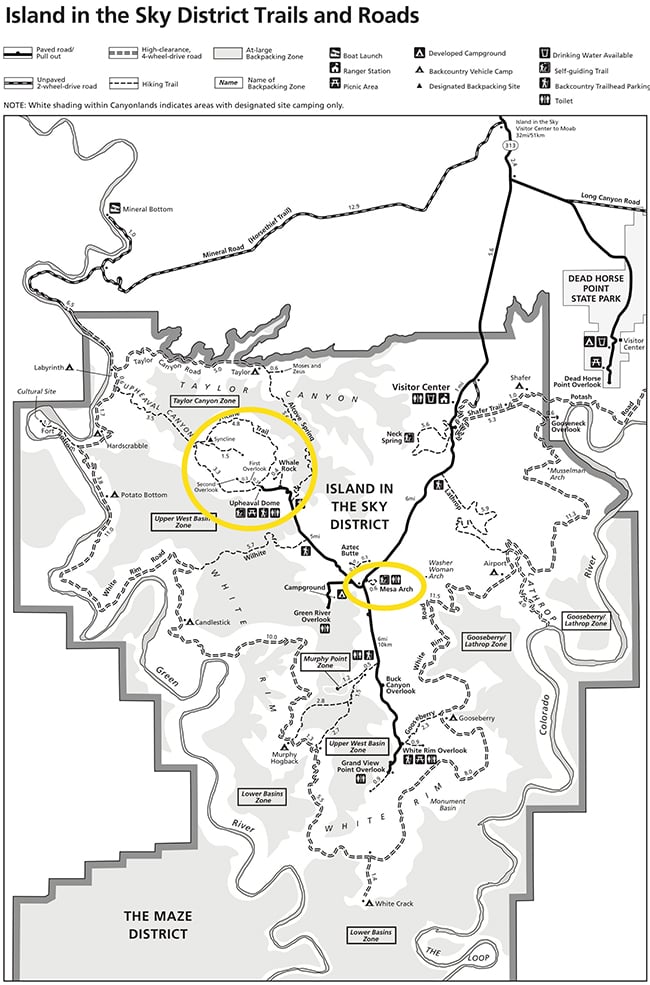
As mentioned in previous Trails I’ve Hiked articles, each unit of the National Park System has at least one must-hike trail. For the Island-in-the-Sky District of Canyonlands National Park in Utah, there are two must-hike trails: Mesa Arch Trail and Upheaval Dome. They are definitely the two most popular trails within this district, as attested to by packed parking lots making it necessary to visit very early in the morning or much later in the afternoon.
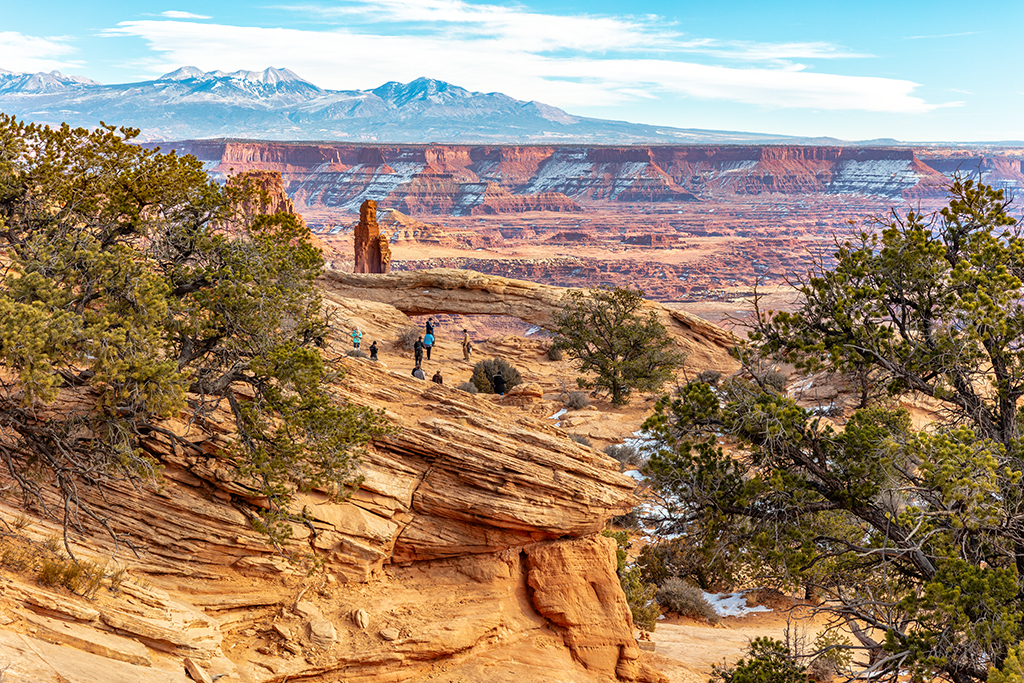
Mesa Arch
Here is a short, easy trail of 0.7 miles (1.1 kilometers) roundtrip leading to an iconic view of John Ford landscape framed by the diminutive Mesa Arch – a pothole arch composed of the bright orange Navajo Sandstone formation - perched right at the edge of a cliff.
A pothole arch forms from water pooling in a depression (a "pothole") on top of the sandstone and slowly eroding through to the cliff edge over time.
Hike this trail in the pre-dawn hours to witness sunrise, and at trail’s end, you’ll be sharing company with a line of photographers and their tripod setups, all waiting to capture the same event.

Hike the trail any time after daylight, and you’ll be waiting your turn to get a selfie framed by the arch with park and Bureau of Land Management landscape in the distant background. It really doesn’t matter when you photograph this vista, though. It’s stunning any time of the day.
The parking lot to the Mesa Arch trailhead is small, considering its popularity. When I visited during a winter mid-morning, there were a few open parking spaces left.

The start of the trail is packed dirt, which later turns to slickrock marked by cairns pointing the way. Because it was winter, portions of the trail were wet, icy, and crusted with a thin layer of snow. To ensure a non-slip trek, I’d attached traction spikes to my boots. The two most popular brands are Kahtoola and Yaktrax.
If you’ve viewed photos of Mesa Arch, you might be led to think this is a large formation. In truth, it is not and as you near trail’s end, you will discover that for yourself.
Because of its ease of access, it might be tempting to walk atop this arch. Please do not. It's strictly prohibited due to extreme danger (a 1,200-foot drop) and fragile geology.
Upheaval Dome
A five-mile (eight-kilometer) drive from Mesa Arch will take you to the Upheaval Dome Overlook Trails. These short hikes (0.6 miles/1 kilometer to the first overlook and 1.2 miles/1.9 kilometers to the second overlook) are both steep, and if you happen to visit during the winter, they may be ice-and/or-snow-encrusted.
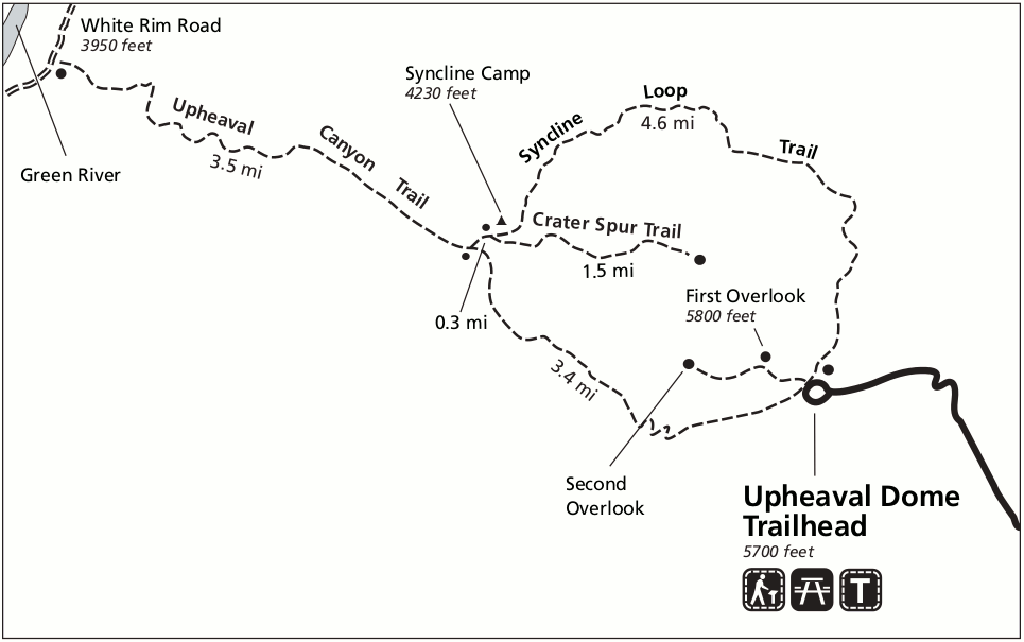
Like the Mesa Arch parking area, the Upheaval Dome parking lot is not much larger and probably gets crowded during a nice summer day. Even during the crisp February chill of winter, there were quite a few people on the trail.
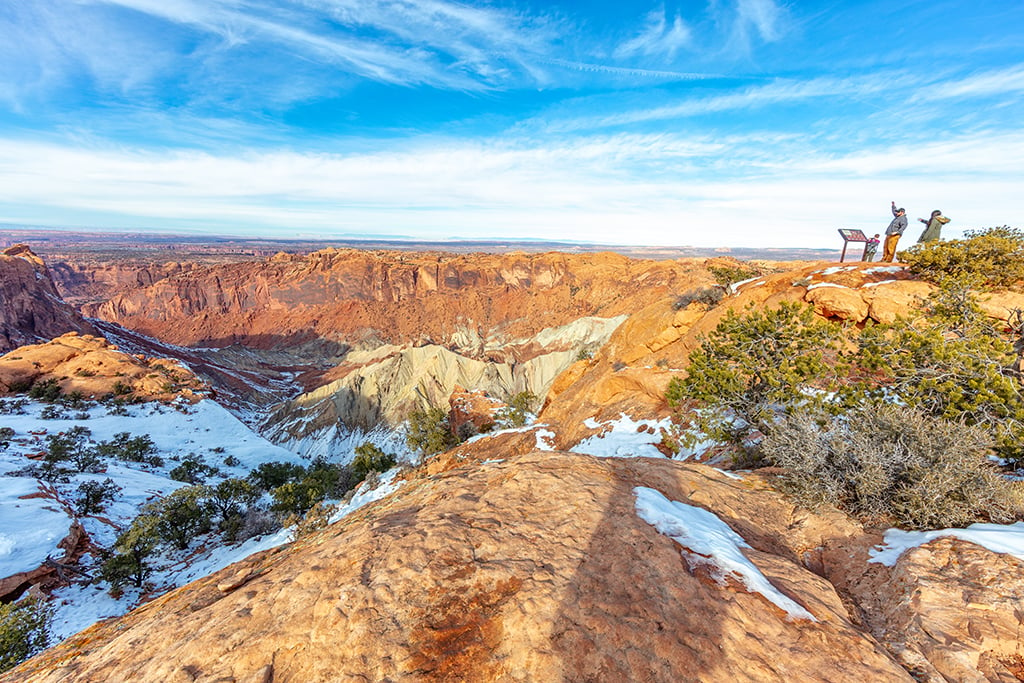
Shortly after starting up the path to the first overlook, you’ll have the opportunity to veer left onto the Syncline Trail, which circles around Upheaval Dome but does not allow a view of the dome’s center. While the hikes to the Upheaval Dome overlooks are considered moderate in difficulty level, the Syncline Trail is strenuous and challenging.
Upheaval Dome is about three miles (five kilometers) across. Its origin is a bit of a mystery and there are two theories as to its formation.
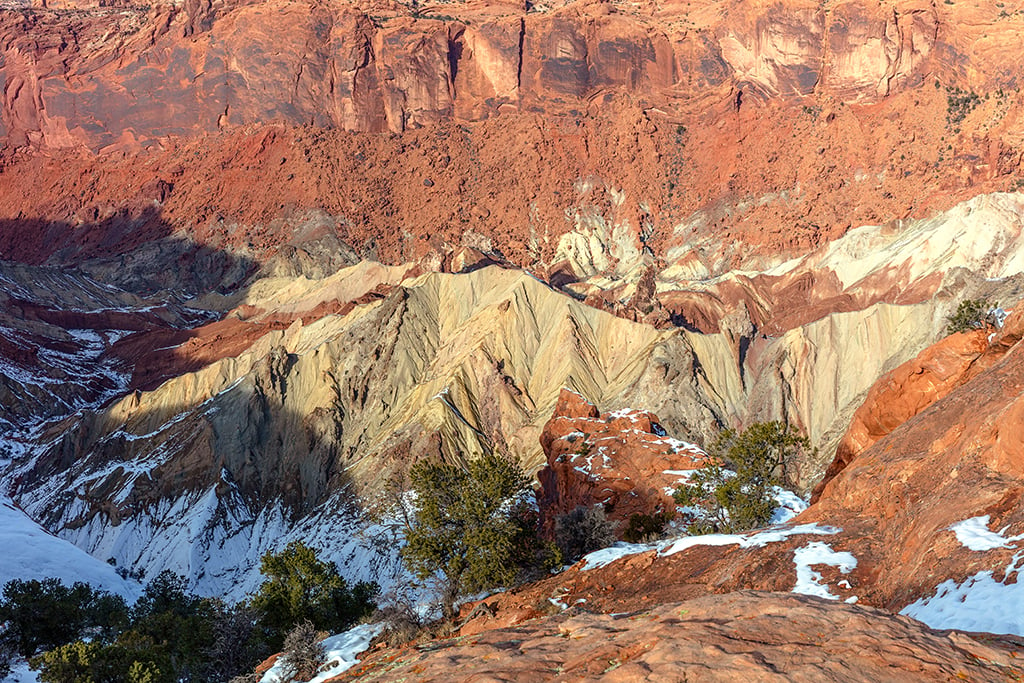
Salt Dome Theory
Much of the park is underlain by a thick layer of salt which formed from the evaporation of an ancient shallow sea. Salt can flow plastically and is thought to have formed a “bubble” that rose to the surface, pushing up and deforming the rock layers above and around this salt bubble.
Impact Crater Theory
Some geologists believe a meteor struck this area 60 million years ago. The resulting explosive impact sent dust and debris high into the atmosphere while creating a crater where it hit.
According to Park Staff:
As the area around Upheaval Dome reached an equilibrium, the rocks underground heaved upward to fill the void left by the impact. Erosion since the impact has washed away any meteorite debris, and now provides a glimpse into the interior of the impact crater, exposing rock layers once buried thousands of feet underground.
Which theory is the most viable? Currently, research findings support the meteorite hypothesis.
Mesa Arch and Upheaval Dome hikes are short enough to be combined for a nice half day out in the park. Neither of them are wheelchair accessible, and while service animals are allowed in national parks, dogs are not allowed on either the Mesa Arch or Upheaval Dome trails.
Stories about:
Story Categories:
A copy of National Parks Traveler's financial statements may be obtained by sending a stamped, self-addressed envelope to: National Parks Traveler, P.O. Box 980452, Park City, Utah 84098. National Parks Traveler was formed in the state of Utah for the purpose of informing and educating about national parks and protected areas.
Residents of the following states may obtain a copy of our financial and additional information as stated below:
- Florida: A COPY OF THE OFFICIAL REGISTRATION AND FINANCIAL INFORMATION FOR NATIONAL PARKS TRAVELER, (REGISTRATION NO. CH 51659), MAY BE OBTAINED FROM THE DIVISION OF CONSUMER SERVICES BY CALLING 800-435-7352 OR VISITING THEIR WEBSITE. REGISTRATION DOES NOT IMPLY ENDORSEMENT, APPROVAL, OR RECOMMENDATION BY THE STATE.
- Georgia: A full and fair description of the programs and financial statement summary of National Parks Traveler is available upon request at the office and phone number indicated above.
- Maryland: Documents and information submitted under the Maryland Solicitations Act are also available, for the cost of postage and copies, from the Secretary of State, State House, Annapolis, MD 21401 (410-974-5534).
- North Carolina: Financial information about this organization and a copy of its license are available from the State Solicitation Licensing Branch at 888-830-4989 or 919-807-2214. The license is not an endorsement by the State.
- Pennsylvania: The official registration and financial information of National Parks Traveler may be obtained from the Pennsylvania Department of State by calling 800-732-0999. Registration does not imply endorsement.
- Virginia: Financial statements are available from the Virginia Department of Agriculture and Consumer Services, 102 Governor Street, Richmond, Virginia 23219.
- Washington: National Parks Traveler is registered with Washington State’s Charities Program as required by law and additional information is available by calling 800-332-4483 or visiting www.sos.wa.gov/charities, or on file at Charities Division, Office of the Secretary of State, State of Washington, Olympia, WA 98504.


National parks and their natural resources belong to you. The National Parks Traveler works to ensure you know how these essential places are being cared for.
Sign Up For Our Weekly Newsletter
Unsubscribe at any time.
INN Member

The easiest way to explore RV-friendly National Park campgrounds.

Here’s the definitive guide to National Park System campgrounds where RVers can park their rigs.
Our app is packed with RVing- specific details on more than 250 campgrounds in more than 70 national parks.
You’ll also find stories about RVing in the parks, tips helpful if you’ve just recently become an RVer, and useful planning suggestions.

