
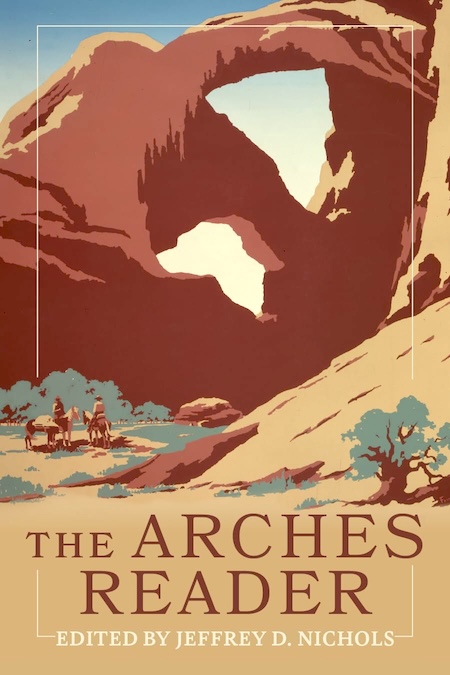
I first visited Arches National Park in 2011 and how I wish I had read a book like this to prepare me for that visit.
I was impressed, of course, by the incredible arches and the landscape, had read Ed Abbey’s Desert Solitaire back when it first came out, had seen photos of the astonishing Delicate Arch, but life had never provided an opportunity to explore the remarkable landscape of southeast Utah and I had read little about Arches other than Abbey.
The University of Utah Press had not yet launched its National Park Readers Series that so far has produced what I would call “companions” for visitors to Grand Teton, Capitol Reef, Glacier, Rocky Mountain, and Zion national parks. If, before visiting any of these parks, you dive into its “reader” the visit will be deeper and more rewarding.
Jeffrey Nichols, a history professor at Salt Lake City’s Westminster University who knows this park well, has brought together 48 selections about Arches National Park and its surroundings that are a delight to read. None are very long, just long enough to inform and provide impressions of this remarkable place.
Historical anecdotes, the earliest written in 1898, the most recent in 2022, brief geological discussions, poems, wonderful reflective essays (Terry Tempest Williams’ “The Coyote Clan” closes the book), and humorous essays provide insights into the park. It opens, as did Desert Solitaire, with, “The First Morning,” Abbey’s account of his introduction to Arches.
Then Amy Irvine sits on Abbey’s grave and “talks” with him. She writes, “We should talk. About the redrock country of Utah. Desert Solitaire was published fifty years ago this year [2018], and as timeless as that book is, things are changing in ways even your prescient, nimble mind could not have imagined.”
Change is a theme that unites the many diverse pieces of this collection.
On that first trip to Arches, we also visited Natural Bridges National Monument, and somehow I missed the fact that the difference between a “natural bridge” and an “arch” is that water flows under a bridge but not an arch. Thoughtful earlier visitors attributed the amazing arches to erosive forces of wind, but while wind played a role, freezing and thawing of water invading sandstone carved out less resistant layers, eventually creating an arch.
The book is full of information like this. One author whose humor adds spice to the book in several contributions describes how the National Park Service, in the 1950s, became concerned about the delicate nature of Delicate Arch, and decided they should “stabilize it.” Jim Stiles opens with a quotation from Abbey in Desert Solitaire who remarked, “There have been some, even in the Park Service, who advocate spraying Delicate Arch with a fixative of some sort – Elmers Glue perhaps or Lady Clairol Spray-net.”
One of the heroes of the Arches National Park story is Bates Wilson, long-time superintendent of the park and key advocate for what became nearby Canyonlands National Park. Wilson didn’t think stabilizing Delicate Arch was a good idea, though he got a lot of pressure from his bosses in the Park Service to do so.
Stiles describes how Bates “simply outlasted the Regional bureaucrats.” He didn’t worry about what nature might do to the arch, but wrote that “the increasing desire of fools to carve their names in public places has reached the highest level possible in Arches at Delicate Arch.”
The Threats
Threats to the park is another storyline through many of the selections.
The challenges of managing Arches National Monument then National Park — poor access, washed out roads, opposition to the park, rude tourists, too many tourists, defacement of park resources, among others, are described.
One selection titled “Managing the Monument: Excerpts from Custodians’ and Superintendents’ Reports, Arches National Monument (1940-1950s)” explains what managers did when visitation was low and amenities few — they kept detailed records of visitation, which grew from few to a few more during this period, inventoried park resources, repaired roads, guided distinguished visitors, and dealt with growing Park Service bureaucracy.
With only one ranger and a maintenance man during much of this period, superintendents found themselves on the end of a shovel now and then.
Other selections include “Commendations and Complaints,” “Reaction to the Expansion of Arches” — comments at a hearing were negative after Lyndon Johnson enlarged the monument without what locals and Utah politicians deemed inadequate consultation with them — and “Dealing with Cremains,” a short description of how one patient and clever superintendent dealt with a man who wished to scatter remains in the park but did not think he needed a required permit “and there was nothing I or the park rangers could do about it.”
The book offers many insights in what park managers have had to deal with over many years.
Searching For Oil And Gas
The stories told in this book are entertaining, whether it be the story of how Charles Steen struck it rich with uranium (outside the monument), early settler encounters with resident First Peoples, children growing up in Arches, or rescues of visitors.
One great story was contributed by Utah antiquarian bookseller Ken Sanders, titled “The Pasty White Shellfish Comes to Arches National Park.” Sanders tells how he became an Earth First! activist and as “minister of Information for EF!” helped organize a “funeral party” at a 20th anniversary celebration for Lake Powell and the Glen Canyon Dam. After this caper, for which he had prepared dummies to satirize the bad guys who had and were destroying Glen Canyon, he capitalized on an opportunity to make a point at Secretary of Interior James Watt’s expense when the secretary made a brief photo-op visit to Arches.
Knowing Watt would go to The Windows for the photos, Ken and a helper placed at the North Window the doppelganger dummy of Watt that had been used in the earlier theatrics at the “celebration.” Sanders writes, “The James Watt dummy was placed, in his suit, down on his knees, his upraised hands crushing a pair of Coors Beer cans while beseeching the heavens, 666 painted on his forehead. The pasty white shellfish (or at least his dummy) had arrived.”
“The following day,” Sanders continues, “on national TV, his face red and contorted with rage . . . Watt spewed and sputtered against ‘those vandals who would destroy our national parks.’ Oddly, he was talking about himself and the Coors Mafia Reagan had appointed to rape America’s public lands.”
He adds, “I will leave to the reader to decide who were the real vandals destroying America’s National Parks and wilderness areas back in the 1980s.”
The infamous Secretary Watt was of course the “Pasty White Shellfish” of the title.
Following Sanders’ hilarious story is Jim Stiles’ “Tourists in the Vortex” which opens as follows:
“Sitting helplessly and innocently in the center of this ugly debate about the future of the rural West is the hapless tourist himself. Maligned and beloved, praised and condemned, urged to stay longer and encouraged to leave sooner he stands at the Moab Information Center, bewildered, confused, and wanting the answer to the one pressing question that matters most, driven by the most painful of agonies, the distended bladder and a place to relieve it.”
Stiles shares many hilarious tourist anecdotes and critiques, then offers satirical tips to how tourists should behave in Arches and other national parks, and in “gateway communities” like Moab. An example for those driving “mega motor homes” is “If you’re in a national park campground, don’t fire up your Briggs & Stratton generator and ask the ranger to help align your satellite dish. Rangers are now heavily armed. Many of them are extremely unstable and on medication or are very bored with their jobs and on medication. The two conditions are interchangeable.”
Stiles ought to know. He was a seasonal ranger at Arches for many years but moved on to be a writer, publisher of the Canyon Country Zephyr, and author of the book Brave New West: Morphing Moab at the Speed of Greed. As a ranger at the time of Sanders’ hijinks, he enjoyed the caper Sanders describes, and buried the dummy in the sand near Devil’s Garden campground with its legs sticking up in the air. When asked about the dummy, with a straight face, Ranger Stiles would reply: “That’s the secretary of the Interior, ma’am, searching for oil and gas.”
The Coyote Clan
Such satire is fun, but there is a serious side to the book as well. Brooke Williams writes of “The Colorado: Archetypal River,” Abbey’s “Cliffrose and Bayonets” celebrates the nature of the place in a charming (for him) chapter from Desert Solitaire, and Terry Tempest Williams closes with her essay, “The Coyote Clan.” She writes,
Coyote’s howl above the canyon says the desert may not depend on his life, but his life depends on the desert.
The canyons of southern Utah are giving birth to a Coyote Clan – hundreds, maybe even thousands of individuals who are quietly subversive on behalf of the land. And they are infiltrating our neighborhoods in the most respectable ways, with their long bushy tails tucked discreetly inside their pants or beneath their skirts.
Members of the Clan are not easily identified, but there are clues. You can see it in their eyes. They are joyful and they are fierce. They can cry louder and laugh harder than anyone on the planet. And they have enormous range.
The Coyote Clan is a raucous bunch: they have drunk from desert potholes and belched forth toads. They tell stories with such virtuosity that you’ll swear you have been in the presence of preachers.
These words were written in 1989, and as we read this book aloud this summer, remembering our visits to Arches National Park, my wife and I couldn’t help but think about the plight of Arches, of all national parks today, in 2025, the Age of Trump, who seems to care nothing for public land and for what Americans think of it — even national parks.
Is the Coyote Clan still with us 36 years after Williams announced its presence? Yes it is, and “subversives on behalf of the land” are more necessary now and have more work to do than ever. The Arches Reader presents the story of this one park and the many folks who have made it what it is today.
The stories of all the national parks and monuments are stories of people who cared and worked on behalf of the land. We cannot let their legacies be undone, and this book is a timely reminder of why we cannot.
Stories about:
Story Categories:
A copy of National Parks Traveler's financial statements may be obtained by sending a stamped, self-addressed envelope to: National Parks Traveler, P.O. Box 980452, Park City, Utah 84098. National Parks Traveler was formed in the state of Utah for the purpose of informing and educating about national parks and protected areas.
Residents of the following states may obtain a copy of our financial and additional information as stated below:
- Florida: A COPY OF THE OFFICIAL REGISTRATION AND FINANCIAL INFORMATION FOR NATIONAL PARKS TRAVELER, (REGISTRATION NO. CH 51659), MAY BE OBTAINED FROM THE DIVISION OF CONSUMER SERVICES BY CALLING 800-435-7352 OR VISITING THEIR WEBSITE. REGISTRATION DOES NOT IMPLY ENDORSEMENT, APPROVAL, OR RECOMMENDATION BY THE STATE.
- Georgia: A full and fair description of the programs and financial statement summary of National Parks Traveler is available upon request at the office and phone number indicated above.
- Maryland: Documents and information submitted under the Maryland Solicitations Act are also available, for the cost of postage and copies, from the Secretary of State, State House, Annapolis, MD 21401 (410-974-5534).
- North Carolina: Financial information about this organization and a copy of its license are available from the State Solicitation Licensing Branch at 888-830-4989 or 919-807-2214. The license is not an endorsement by the State.
- Pennsylvania: The official registration and financial information of National Parks Traveler may be obtained from the Pennsylvania Department of State by calling 800-732-0999. Registration does not imply endorsement.
- Virginia: Financial statements are available from the Virginia Department of Agriculture and Consumer Services, 102 Governor Street, Richmond, Virginia 23219.
- Washington: National Parks Traveler is registered with Washington State’s Charities Program as required by law and additional information is available by calling 800-332-4483 or visiting www.sos.wa.gov/charities, or on file at Charities Division, Office of the Secretary of State, State of Washington, Olympia, WA 98504.


National parks and their natural resources belong to you. The National Parks Traveler works to ensure you know how these essential places are being cared for.
Sign Up For Our Weekly Newsletter
Unsubscribe at any time.
INN Member

The easiest way to explore RV-friendly National Park campgrounds.

Here’s the definitive guide to National Park System campgrounds where RVers can park their rigs.
Our app is packed with RVing- specific details on more than 250 campgrounds in more than 70 national parks.
You’ll also find stories about RVing in the parks, tips helpful if you’ve just recently become an RVer, and useful planning suggestions.

