
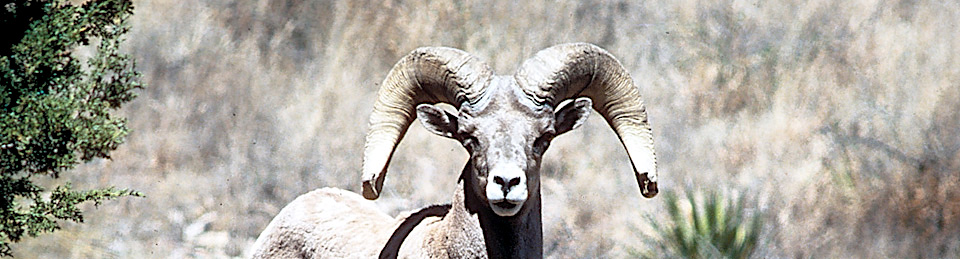
Big Bend National Park staff are working to reduce the numbers of non-native Barbery sheep to protect the park's small numbers of Desert bighorns (above)/NPS file
Airborne sharpshooters will take to the skies over Big Bend National Park on Sunday in a bid to reduce the numbers of non-native Barbary sheep in the park so they don't jeopardize the small numbers of native Desert Bighorn sheep.
The Deadhorse Mountains and surrounding areas, including the Dagger Flat Road and Old Ore Road, will be closed to the public from August 11 – August 17 while the Park Service works with Texas Parks and Wildlife to remove the Barbary Sheep using helicopters and staff trained in aerial shooting operations.
The purpose of the closure is to keep visitors safe. All paved roads will remain open.
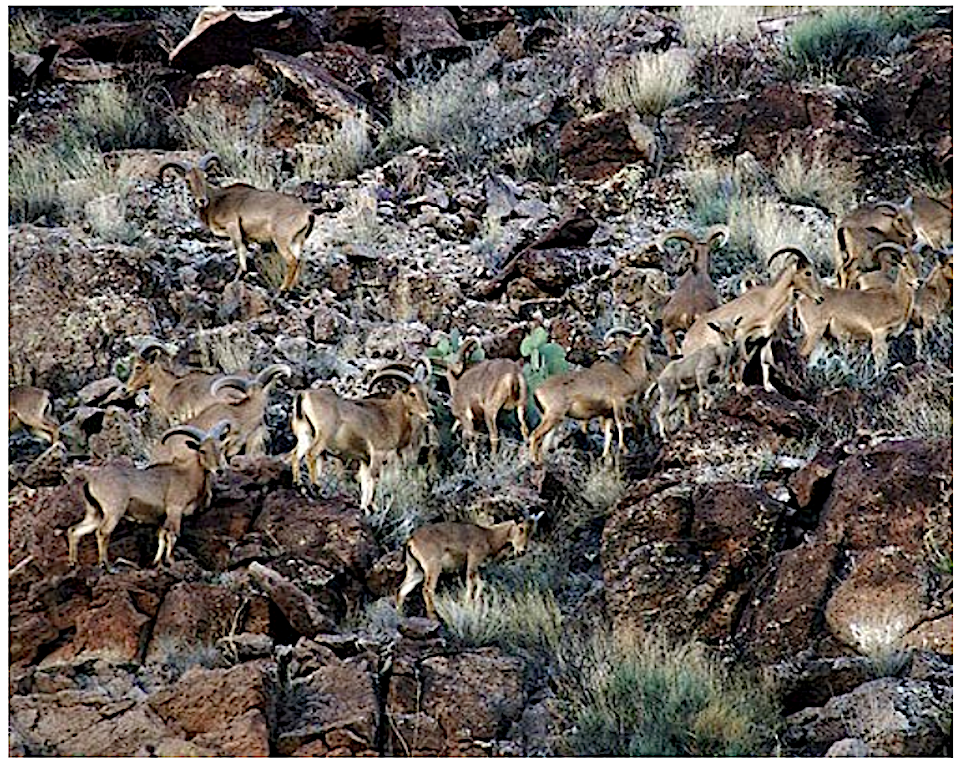
Efforts are being made to remove non-native Barbary sheep from Big Bend National Park/NPS
Barbary sheep (aoudad) have been in the park for the past three decades and have increased significantly in recent years. Hundreds of Barbary sheep inhabit the park, but the park has only one very small known population of native Desert Bighorn sheep. Barbary sheep control is necessary as they compete with native species including preventing Desert Bighorn from accessing water, threaten biodiversity, and impair park visitor’s ability to experience natural conditions and scenery.
This effort is part of Big Bend’s long-term, integrated approach to control exotic animals and protect park resources. Management of aoudad is in keeping with the Big Bend Exotic Animal Management Plan and Environmental Assessment, finalized in June, 2018. To see this plan, visit this site.
Stories about:
Story Categories:
A copy of National Parks Traveler's financial statements may be obtained by sending a stamped, self-addressed envelope to: National Parks Traveler, P.O. Box 980452, Park City, Utah 84098. National Parks Traveler was formed in the state of Utah for the purpose of informing and educating about national parks and protected areas.
Residents of the following states may obtain a copy of our financial and additional information as stated below:
- Florida: A COPY OF THE OFFICIAL REGISTRATION AND FINANCIAL INFORMATION FOR NATIONAL PARKS TRAVELER, (REGISTRATION NO. CH 51659), MAY BE OBTAINED FROM THE DIVISION OF CONSUMER SERVICES BY CALLING 800-435-7352 OR VISITING THEIR WEBSITE. REGISTRATION DOES NOT IMPLY ENDORSEMENT, APPROVAL, OR RECOMMENDATION BY THE STATE.
- Georgia: A full and fair description of the programs and financial statement summary of National Parks Traveler is available upon request at the office and phone number indicated above.
- Maryland: Documents and information submitted under the Maryland Solicitations Act are also available, for the cost of postage and copies, from the Secretary of State, State House, Annapolis, MD 21401 (410-974-5534).
- North Carolina: Financial information about this organization and a copy of its license are available from the State Solicitation Licensing Branch at 888-830-4989 or 919-807-2214. The license is not an endorsement by the State.
- Pennsylvania: The official registration and financial information of National Parks Traveler may be obtained from the Pennsylvania Department of State by calling 800-732-0999. Registration does not imply endorsement.
- Virginia: Financial statements are available from the Virginia Department of Agriculture and Consumer Services, 102 Governor Street, Richmond, Virginia 23219.
- Washington: National Parks Traveler is registered with Washington State’s Charities Program as required by law and additional information is available by calling 800-332-4483 or visiting www.sos.wa.gov/charities, or on file at Charities Division, Office of the Secretary of State, State of Washington, Olympia, WA 98504.


National parks and their natural resources belong to you. The National Parks Traveler works to ensure you know how these essential places are being cared for.
Sign Up For Our Weekly Newsletter
Unsubscribe at any time.
INN Member

The easiest way to explore RV-friendly National Park campgrounds.

Here’s the definitive guide to National Park System campgrounds where RVers can park their rigs.
Our app is packed with RVing- specific details on more than 250 campgrounds in more than 70 national parks.
You’ll also find stories about RVing in the parks, tips helpful if you’ve just recently become an RVer, and useful planning suggestions.


Comments
Seems like they are missing an opportunity to use the Barbary sheep as an income scource by allowing a special season for hunters to reduce the population. Instead they are going to spend a few hundred thousand flying around making kills for no income.
Based on past experience, in most cases it costs more to manage a public hunt, making sure the non-native animals are removed, not the native ones, and no damage to vegetation and archeological sites, than it costs to cooperate with state Parks & Wildlife on reduction if not eradication efforts. There's also the issue of killing females affects their populations more, but trophy hunters prefer killing males. And, note that these Barnary Sheep, and the Oryx & Ibex in White Sands, were deliberately introduced by state fish & game agencies to increase opportunities for hunters (also, largely funded by hunters via licenses). If trophy hunters were able to sufficiently reduce the population, that would have happened in areas outside the National Parks long before the introduced populations spread into the parks. Personally, I'm all for more hunting permits issues for these introduced big game on state lands outside of the parks.
Would it be possible to tranquilize the offending sheep and transport them to areas where they would be more beneficial? Mass slaughtering of defenseless animals is inhumane.