
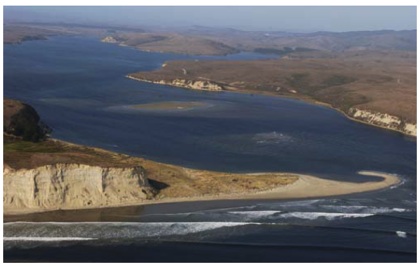
Drakes Estero at Point Reyes National Seashore, NPS photo.
The recent National Research Council report on the National Park Service’s draft environmental plan of Drakes Estero’s future has provided Interior Secretary Salazar with even further support to protect this valuable estuary in Point Reyes National Seashore.
The report, the latest in exhaustive and expensive environmental review process, evaluated the data and scientific conclusions of the draft environmental plan that analyzed protecting the Estero - the West Coast’s only marine wilderness area - or allowing an oyster company to extend its permit beyond its long-planned sunset. It also found the National Park Service generally used the best available data, formed reasonable scientific conclusions, and provided suggestions for the Park Service to consider in their final environmental plan, such as more clear communication of the uncertainties that exist in all scientific information.
In formulating its final plan, the agency has to consider its legal and policy goals, as well as feedback from a Department of the Interior-commissioned independent peer review, a U.S. Marine Mammal Commission review, a public comment period where tens of thousands of Americans across the country weighed in, and the NRC review. The report is further confirmation that we need to preserve Drakes Estero by turning it into a full-fledged wilderness for the benefit of visitors and wildlife.
Easy to miss in the debate is that this issue will be decided on what action is most consistent with national park law and policy. Many issues, including the company’s long history of state and federal permit violations, will factor into the equation. The most recent development came in July 2012, when the State of California Coastal Commission issued an enforcement letter to the oyster company, outlining how the company has, amongst other things, admitted to violating harbor seal protections since 2008 and has failed to deal with its substantial marine debris pollution problem that litters the national seashore beaches with plastic tubes.
While the NRC and other review panels did not deal with the National Park Service’s policy goals or the company’s violations, their work reinforces the Park Service’s conclusion in their draft Environmental Impact Statement (DEIS) that the “environmentally preferred alternative” is to sunset the oyster company’s permit as long planned. Specific examples from the report on impacts to plant and animal species include:
* Impacts to sensitive eelgrass: “…the committee finds that the data support the DEIS findings; alternatives B and C [oyster permit extension] would sustain the current level of adverse impact…”
* Impacts to birds: “The committee finds that the DEIS conclusion that alternative A [wilderness protection] would have a beneficial impact, because habitat would improve for foraging and migratory birds, is valid and scientifically sound.”
* Impacts to harbor seals, which have received significant public attention: “Overall, the best available scientific information was used in the DEIS” and “Viewed alongside peer review results of short-term disturbance effects in other areas (reviewed in the NRC, 2009 report), the information presented in the DEIS supports the conclusion that alternatives B, C, and D [variations of an oyster permit extension] would likely result in moderate adverse impacts on harbor seals due to potential displacement from preferred haul-out sites…In contrast, alternative A [wilderness protection], after the initial short-term impacts during equipment review removal, would be expected to lead to fine scale changes in harbor seal distribution that reflect natural site preference and responses to natural, as opposed to anthropogenic, environmental variation.”
Indeed, this thorough review process provides Interior Secretary Salazar with a clear and actionable path to honoring our national heritage by protecting this estuary this year. Drakes Estero is one of our country’s greatest places and is long overdue for the protection it deserves. Characteristics such as its unique and rich plant and animal life and the intended solitude that so many visitors expect should be protected this year by the National Park Service as they have done at other spectacular places around the country.
Drakes Estero provides the public with a significant opportunity to conserve a valuable estuary for the benefit and enjoyment of current and future generations. Interior Secretary Salazar should join the tens of thousands of Americans and notable scientists such as E.O. Wilson and Sylvia Earle, and honor this deal to transition land use to a higher and better purpose.
Neal Desai is the Pacific Region Associate Director for the National Parks Conservation Association.
Story Categories:
A copy of National Parks Traveler's financial statements may be obtained by sending a stamped, self-addressed envelope to: National Parks Traveler, P.O. Box 980452, Park City, Utah 84098. National Parks Traveler was formed in the state of Utah for the purpose of informing and educating about national parks and protected areas.
Residents of the following states may obtain a copy of our financial and additional information as stated below:
- Florida: A COPY OF THE OFFICIAL REGISTRATION AND FINANCIAL INFORMATION FOR NATIONAL PARKS TRAVELER, (REGISTRATION NO. CH 51659), MAY BE OBTAINED FROM THE DIVISION OF CONSUMER SERVICES BY CALLING 800-435-7352 OR VISITING THEIR WEBSITE. REGISTRATION DOES NOT IMPLY ENDORSEMENT, APPROVAL, OR RECOMMENDATION BY THE STATE.
- Georgia: A full and fair description of the programs and financial statement summary of National Parks Traveler is available upon request at the office and phone number indicated above.
- Maryland: Documents and information submitted under the Maryland Solicitations Act are also available, for the cost of postage and copies, from the Secretary of State, State House, Annapolis, MD 21401 (410-974-5534).
- North Carolina: Financial information about this organization and a copy of its license are available from the State Solicitation Licensing Branch at 888-830-4989 or 919-807-2214. The license is not an endorsement by the State.
- Pennsylvania: The official registration and financial information of National Parks Traveler may be obtained from the Pennsylvania Department of State by calling 800-732-0999. Registration does not imply endorsement.
- Virginia: Financial statements are available from the Virginia Department of Agriculture and Consumer Services, 102 Governor Street, Richmond, Virginia 23219.
- Washington: National Parks Traveler is registered with Washington State’s Charities Program as required by law and additional information is available by calling 800-332-4483 or visiting www.sos.wa.gov/charities, or on file at Charities Division, Office of the Secretary of State, State of Washington, Olympia, WA 98504.


National parks and their natural resources belong to you. The National Parks Traveler works to ensure you know how these essential places are being cared for.
Sign Up For Our Weekly Newsletter
Unsubscribe at any time.
INN Member

The easiest way to explore RV-friendly National Park campgrounds.

Here’s the definitive guide to National Park System campgrounds where RVers can park their rigs.
Our app is packed with RVing- specific details on more than 250 campgrounds in more than 70 national parks.
You’ll also find stories about RVing in the parks, tips helpful if you’ve just recently become an RVer, and useful planning suggestions.


Comments
I'll just say all my previous arguments can be found in the search engine. However, I keep on hearing the talking point about this possibly being the only marine wilderness area on the west coast. Abbotts Lagoon and Estero de Limantour are also in the wilderness plan as potential wilderness. In addition to that, there are already three marine wilderness areas off the coast of Washington, Oregon, and California as spelled out in the maps.
Rocks and Islands Wilderness (BLM):
http://www.wilderness.net/index.cfm?fuse=NWPS&sec=wildView&WID=703
http://www.wilderness.net/map.cfm?xmin=-13801272.5125&ymin=4859714.5692&...
Oregon Islands Wilderness (FWS):
http://www.fws.gov/refuges/profiles/index.cfm?id=13599
http://www.wilderness.net/index.cfm?fuse=NWPS&sec=wildView&WID=430
http://www.wilderness.net/map.cfm?xmin=-13795566.5072&ymin=5160752.7573&...
Washington Islands Wilderness (FWS):
http://www.wilderness.net/index.cfm?fuse=NWPS&sec=wildView&wname=Washing...
http://www.wilderness.net/map.cfm?xmin=-13823981.0978&ymin=5963835.8801&...
This whole situation is getting ridiculous, especially with the continued permit violations and continued studies. The policy treshold is what the NPS will have to follow and make its decision on. I am surprised the author didn't bring up how Senator Dianne Feinstein has been interferring and using flawed science (see this: http://www.eastbayexpress.com/ebx/dianne-feinsteins-scientist-rebuked/Co...).
Too bad they will never kick the mountain bikers off the "wilderness" trails in the area. They can't catch them.
Mr. Desai's article is correct when it states that Drakes Estero is the only Congressionally-designated marine wilderness on the West Coast.
y_p_w's conflicting aruments are mistaken: the supposedly "marine" wilderness areas managed by BLM and FWS are rocks and islands, not marine areas. Abbotts Lagoon is a fresh-water-body rarely open to marine influence, not like Drakes, a salt-water-body regularly open. Estero de Limantour is a part of Drakes Estero...the only part that has been restored. Thus none of y_p_w's examples support y_p_w's argument.
Virtually all large estuaries on the West Coast, except for Drakes, have been so heavily modified by human use that it is impractical to restore their natural processes. Drakes is the one area on the West Coast designated by Congress to restore this wilderness touchstone.
In 2005, the last 7 of the final 40 years of operating rights in the Estero were sold with full knowledge that these rights (which conflicted with wilderness but would be honored to their end in 2012) would not be renewed. But the new company then unleashed a blizzard of baseless lawsuits, bogus science and high-powered lobbyists to attempt to confuse (as y_p_w's comments do) and to overturn by political means the will of the American public.
The question that Mr. Desai's article legitimately raises is whether this one company should be allowed to set a precedent that would undermine not just Point Reyes National Seashore, but wilderness nationwide: http://elq.typepad.com/currents/2012/08/currents39-05-greennylen-2012-0826.html