
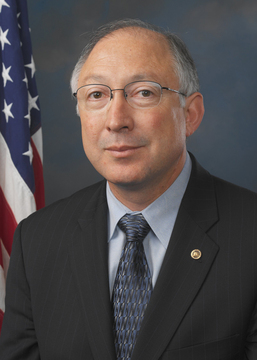
Sen. Salazar's selection as the next Interior secretary is being labeled a failure by the Center for Biological Diversity, but seen as a brilliant move by The Wilderness Society.
The pick of U.S. Senator Ken Salazar as the next Interior secretary is being labeled a failure by the Center for Biological Diversity. But the folks at The Wilderness Society say it's a great choice.
In a blistering reaction to word of that nomination, the executive director of the Center for Biological Diversity calls Mr. Salazar the wrong choice to lead the massive department back to respectability.
As the overseer of the National Park Service, the Bureau of Land Management, the Mineral Management Services, the U.S. Fish and Wildlife Service, and the Endangered Species Act, the Secretary of the Interior is most important position in the protection of America's lands, waters, and endangered species, says Kieran Suckling.
The Department of the Interior, he notes, has been rocked by scandals during the Bush administration, most revolving around corrupt bureaucrats overturning and squelching agency scientists as they attempted to protect endangered species and natural resources from exploitation by developers, loggers, and oil and gas development.
As recently as Monday, the Interior Department Inspector General issued another in a string of reports finding that top Department officials systematically violated laws and regulations in order to avoid or eliminate environmental protections.
"The Department of the Interior desperately needs a strong, forward looking, reform-minded secretary," said Mr. Suckling. "Unfortunately, Ken Salazar is not that man. He endorsed George Bush's selection of Gale Norton as Secretary of Interior, the very woman who initiated and encouraged the scandals that have rocked the Department of Interior. Virtually all of the misdeeds described in yesterday's Inspector General expose occurred during the tenure of the person Ken Salazar advocated for the position he is now seeking."
Mr. Suckling does note that the senator "has promoted some good environmental actions and fought against off-road vehicle abuse." But yet, "his overall record is decidedly mixed, and is especially weak in the arenas most important to the next Secretary of the Interior: protecting scientific integrity, combating global warming, reforming energy development and protecting endangered species."
Among Sen. Salazar's record that Mr. Suckling cited as disappointing were the senator's vote against increased fuel efficiency standards for the U.S. automobile fleet; vote to allow offshore oil drilling along Florida's coast; vote to allow the Army Corps of Engineers to ignore global warming impacts in their water development projects; vote against the repeal of tax breaks for Exxon-Mobil; vote to support subsidies to ranchers and other users of public forest and range lands; a threat to sue the U.S. Fish and Wildlife Service when its scientists determined the black-tailed prairie dog may be endangered, and; opposition to increased protection for endangered species and the environment in the Farm Bill.
"(President-elect) Obama’s choices for Secretary of Energy and his Climate Change Czar indicate a determined willingness to take on global warming," added Mr. Suckling. "That team will be weakened by the addition of Ken Salazar, who has fought against federal action on global warming, against higher fuel efficiency standards, and for increased oil drilling and oil subsidies."
In addition to his misstep on Ms. Norton, Mr. Suckling notes that Sen. Salazar endorsed the elevation of William Myers III to the federal bench. Mr. Myers was a former Interior Department Solicitor and lobbyist for the ranching industry. Senator Patrick Leahy, D-Vt., called him ''the most anti-environmental candidate for the bench I have seen in 37 years in the Senate."
Bizarrely, says Mr. Suckling, Sen. Salazar praised Mr. Myers' "outstanding legal reasoning" regarding endangered species, Indian affairs, federal lands and water, timber, and fish and wildlife issues. The American Bar Association rated Meyers as "not qualified."
"One of the most important jobs of the Secretary of the Interior is to help pick dozens of critically important political appointees to oversee America's conservation system,” Suckling said. “His past misjudgments of Norton, Meyers and Gonzales give us little confidence he will choose wisely in the future."
The Center for Biological Diversity is a national nonprofit conservation organization with 200,000 members and online activists dedicated to the protection of endangered species and wild places.
But over at The Wilderness Society, President Bill Meadows is applauding Sen. Salazar's selection, much as the National Parks Conservation Association did the other day.
"Senator Salazar is an excellent choice to lead the Department of the Interior at a critical time when the West faces extraordinarily complex energy, conservation, and development challenges. He has a lifelong understanding and involvement in the West’s public lands issues and, as Senator, has demonstrated time and again that protecting Colorado’s natural features is a priority for him," said Mr. Meadows. "He understands the need to defend the West’s land, water, wildlife, and communities while appropriately exploring for oil and gas and other extractive resources.
"We at The Wilderness Society have always been impressed by the openness with which Senator Salazar conducts his responsibilities as senator on public lands issues. Because he has been a leader in negotiations on several Colorado wilderness bills that are poised to be passed by Congress, including Dominguez Canyon and Rocky Mountain National Park, we are confident that, in his new role, he will continue his work to protect the West’s most beautiful and ecologically significant landscapes."
Story Categories:
A copy of National Parks Traveler's financial statements may be obtained by sending a stamped, self-addressed envelope to: National Parks Traveler, P.O. Box 980452, Park City, Utah 84098. National Parks Traveler was formed in the state of Utah for the purpose of informing and educating about national parks and protected areas.
Residents of the following states may obtain a copy of our financial and additional information as stated below:
- Florida: A COPY OF THE OFFICIAL REGISTRATION AND FINANCIAL INFORMATION FOR NATIONAL PARKS TRAVELER, (REGISTRATION NO. CH 51659), MAY BE OBTAINED FROM THE DIVISION OF CONSUMER SERVICES BY CALLING 800-435-7352 OR VISITING THEIR WEBSITE. REGISTRATION DOES NOT IMPLY ENDORSEMENT, APPROVAL, OR RECOMMENDATION BY THE STATE.
- Georgia: A full and fair description of the programs and financial statement summary of National Parks Traveler is available upon request at the office and phone number indicated above.
- Maryland: Documents and information submitted under the Maryland Solicitations Act are also available, for the cost of postage and copies, from the Secretary of State, State House, Annapolis, MD 21401 (410-974-5534).
- North Carolina: Financial information about this organization and a copy of its license are available from the State Solicitation Licensing Branch at 888-830-4989 or 919-807-2214. The license is not an endorsement by the State.
- Pennsylvania: The official registration and financial information of National Parks Traveler may be obtained from the Pennsylvania Department of State by calling 800-732-0999. Registration does not imply endorsement.
- Virginia: Financial statements are available from the Virginia Department of Agriculture and Consumer Services, 102 Governor Street, Richmond, Virginia 23219.
- Washington: National Parks Traveler is registered with Washington State’s Charities Program as required by law and additional information is available by calling 800-332-4483 or visiting www.sos.wa.gov/charities, or on file at Charities Division, Office of the Secretary of State, State of Washington, Olympia, WA 98504.


National parks and their natural resources belong to you. The National Parks Traveler works to ensure you know how these essential places are being cared for.
Sign Up For Our Weekly Newsletter
Unsubscribe at any time.
INN Member

The easiest way to explore RV-friendly National Park campgrounds.

Here’s the definitive guide to National Park System campgrounds where RVers can park their rigs.
Our app is packed with RVing- specific details on more than 250 campgrounds in more than 70 national parks.
You’ll also find stories about RVing in the parks, tips helpful if you’ve just recently become an RVer, and useful planning suggestions.


Comments
I will hope for the best and withhold judgement until we see what he does after he takes office. At this point, almost anyone will be an improvement !
If the radical leftist Suckling doesn't like the pick, then I guess I love it.
The Wilderness Society and NPCA are definitely more in tune with the average, working American.
I read the Wikipedia entries for the Center for Biological Diversity, and for Kieran Suckling, and what I see is very close to a one-man entity with a specialty in media-promotion, and lawsuits.
It appears they do not actually do much of anything else.
Kieran Suckling, in his response to prospective Sec. of Interior appointee Ken Salazar, strikes me as the fellow at the protest with extra-strong lungs, and a chunk of brick cupped in his hand.
Roger, I couldn't agree more. Just goes to show that the Radicalized Enviros can't win 'em all!
I say let's let Mr. Salazar actually work at his post for a while before we start bashing him. Kinda like the way we should let the President Elect serve a few days before we start praising him, and renaming roads and schools. Just a bit premature in both cases, IMO.
Ted, good to see you back in the fray, Sir! Sounds like you had some great adventures during your absence. I agree with your comment as well. Perhaps Mr. Suckling will try to sue his way around this issue?
Have you kept abreast of the CHNSRA case? Much has transpired since we discussed it last, a mixed bag for all sides, at best.
Thanks dapster! I did see a CHNSRA comment the other day as I refreshed on NPT, but have seen nothing in the news. Can you point me to a thread that will update me?
Our Arctic outbreak dumped snow on the Olympic Peninsula last Friday, then froze it, then the winds yanked everything around (fortunately missed the powerlines..), then we got a couple days of cold sunshine. Yesterday, the front return with more moisture and we are now getting a major dump. Six inches of powder on the beaches of Juan de Fuca Strait. A foot or more upland. With a few more minutes of daylight, I'll be out with the camera ... it would a perfect photo-op, if it wasn't still snowing fairly hard!
Tomorrow is supposed to clear off, and I'm going over to my trail-job and do some shop-work. Hope to hike out and get some snow-pics on the trail, though I won't be able to do any cutting. I'll upload some and post links.
Yes, I've missed the good coverage on National Parks Traveler, and the quality give & take! :-)
You betcha! Here's a link to a local newspaper, "The Island Free Press", which has covered all the NPS Negotioated Rulemaking Committee meetings:
http://www.islandfreepress.org/CatBeachAccessIssues.html
You can also find links to the first 2 meetings to be videotaped. The viewing is interesting, but long. Watch some if you've got the time. Some of the most intersting to me are on the 11/14 tape, where a UFSWS Turtle expert gave a presentation comparing beach/vehicle useage on Daytona Beach to that on Hatteras. That made for some interesting debate in the Q&A later on.
I was lucky enough to attend the 11/14-15 meetings, and I don't think I've ever seen such a polarized and deadlocked panel. Word is some headway has been made during the 12/11-12 meetings, but for that group to reach consensus on a decision as simple as "What's for lunch" seems impossible. I smell more lawsuits, sadly...
Crazy weather out your way and other points West! Snow in your rainforest, snow in Las Vegas, sounds to me like the Pacific Decadal Oscillation has indeed reversed, as has been postulated for some time now. The recent changes in the Humboldt would seem to firm up that theory also. Stay warm and safe out there. Please do share some of those pics!
You've missed quite a bit! Guns in the Parks has been the issue du jour of late, along with the election, etc. All good stuff from Kurt et al as usual!
Good to have you back.
dap